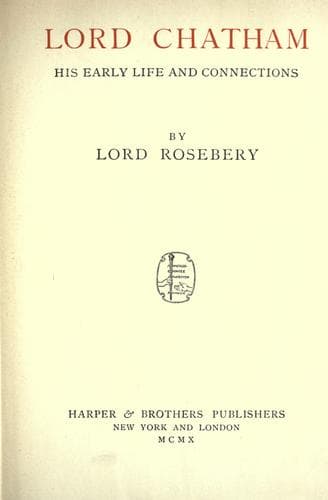
Lord Chatham, His Early Life and ConnectionsRosebery, Archibald Philip Primrose, Earl of
History
Lord Chatham, His Early Life and Connections
Rosebery, Archibald Philip Primrose, Earl of
Pitt, William, Earl of Chatham, 1708-1778
His foible, we are told, was avarice. We do not know that he was mean in
his personal expenditure. Waldegrave, again, who was fair, and knew him
better than most men, declared that 'he was always just, and sometimes
charitable, though rarely generous.' He amused himself, we are told,
with counting his guineas in private. That perhaps was not a very royal
occupation, though a nursery rhyme indicates that it is; it may have
been a trick learned when he was poor, or it may have been his
substitute for those games of anxious futility now known as 'patience.'
But the real ground for the charge of avarice in the eyes of his British
subjects was that he accumulated a great treasure in Hanover. If that be
avarice, it was the avarice of the kings who made Prussia, the famous
Frederick and his father. Parsimony in such cases may well be a virtue;
and subjects may even prefer to be ruled by those who possess it rather
than by princes who rear vast and idle palaces like the Bourbons of
Spain and Naples, or live with unbridled extravagance like George IV.
But kings rarely hit the right mean; if they are generous they are
called profuse, if they are careful they are called mean. George's
avarice, if such it was, was a public-spirited avarice. He hoarded for
his own beloved country, he got as much out of his Kingdom as he could
for his Electorate; for he was a Hanoverian first and a Briton a long
way afterwards. But when Hanover needed it, he spent all his hoards on
her behalf ungrudgingly, and died poor.
Public-domain text, read in full here on John Shaqi.
Reviews
Reviews
No reviews yet
Be the first to share your thoughts on this work.
Elsewhere in the archive
Join the Discussion
Join the discussion
Sign in to leave a comment or review.
Sign InorCreate an account