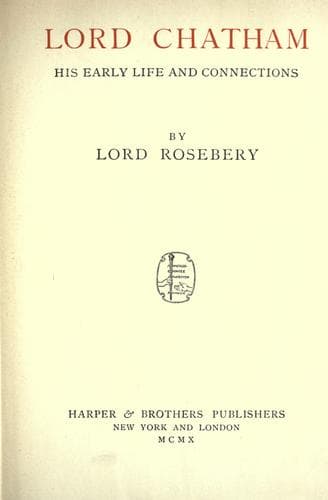
Lord Chatham, His Early Life and ConnectionsRosebery, Archibald Philip Primrose, Earl of
History
Lord Chatham, His Early Life and Connections
Rosebery, Archibald Philip Primrose, Earl of
Pitt, William, Earl of Chatham, 1708-1778
The Sovereign he attacked openly and unsparingly. It was proposed, in
the Address to the Throne, to congratulate the King on his escape from
the dangers of the battle of Dettingen. This Pitt deprecated. 'Suppose,
Sir,' he asked, 'it should appear that His Majesty was exposed to few or
no dangers abroad, but those to which he is daily liable at home, such
as the overturning of his coach or the stumbling of his horse, would not
the address proposed, instead of being a compliment, be an affront and
insult to the Sovereign?' No affront or insult could at any rate be more
stinging or more unfounded than his wanton insinuation. George II. had
the courage of his race, and had displayed it at Dettingen. At first his
runaway horse had almost carried him into the French lines, so he
dismounted and fought on foot for the rest of the day; not leaving the
field until he had created a number of knights banneret; the last
British king to take the field, and the last bannerets to be so
created.[154]
It was vile then to disparage the King's courage, but political life in
those days had no scruple and little shame. The sneers at Hanover with
which this speech was sprinkled were better founded and deserved. But a
serious and reasonable argument, not yet obsolete, pervaded Pitt's
violent rhetoric on this occasion. It was that though the balance of
power concerned all states, it concerned our island state least and last
of all. Moreover, he attacked our recent policy on other grounds. On our
attitude to Austria, then fighting for its integrity under Maria
Theresa, he heaped scorn from another point of view. We had promised her
abundant assistance when she was fighting Prussia alone; when France
intervened we shrank back and left her in the lurch. That, he declared,
was not our only discredit. When Prussia attacked the Queen of Hungary,
and Spain, Poland, and Bavaria laid claim to her father's succession, we
should have known that the preservation of the whole was impossible, and
advised her to yield the part claimed by Frederick. But the words from
the Throne and the speeches of the courtiers had persuaded the Austrian
Government that Great Britain was determined to support her. So great
was the determination, that even Hanover added near one-third to her
army at her own cost, the first extraordinary expense, it was believed,
that Hanover had borne for her purposes since her fortunate conjunction
with England! But then the French intervened. Hanover was in danger, and
so we promptly retired. We gave some money, indeed, but that was because
our ministers contrived to make a job of every parliamentary grant. The
Queen, seeing that she was deserted, came to terms with Frederick, but
much worse terms than he had originally offered. Then was the time for
us to have insisted on her making peace with France and the phantom
Emperor. But we had advised her against this, for no conceivable reason
except apparently that we wished to go on paying the 16,000 Hanoverians
Public-domain text, read in full here on John Shaqi.
Reviews
Reviews
No reviews yet
Be the first to share your thoughts on this work.
Elsewhere in the archive
Join the Discussion
Join the discussion
Sign in to leave a comment or review.
Sign InorCreate an account