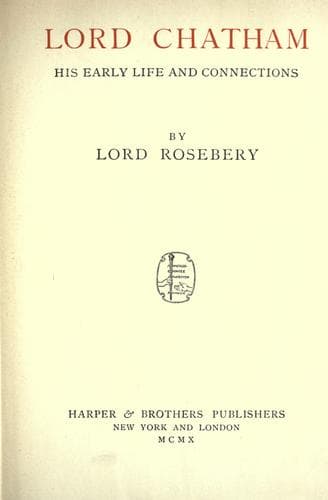
Lord Chatham, His Early Life and ConnectionsRosebery, Archibald Philip Primrose, Earl of
History
Lord Chatham, His Early Life and Connections
Rosebery, Archibald Philip Primrose, Earl of
Pitt, William, Earl of Chatham, 1708-1778
So far as the House of Commons was concerned, this ended the hostilities
against the Hanoverian troops, though the House of Lords continued the
controversy with a debate in which Chesterfield, who outdid Pitt in
violence, delivered a speech which was greatly admired. But a subsidy of
200,000_l._ had to be voted to the King of Sardinia under the treaty of
Worms. This treaty, negotiated by the King and Carteret in Germany
independently of the Home Government, was little relished by that
Government, and offered a tempting target to the warriors of the
Opposition. On a first motion for papers, Pitt was again prominent,
though little of his speech survives. Alluding, however, to a secret
convention attached to the treaty, which Carteret had signed but which
Ministers had refused to ratify, he declared, 'I only wanted the sight
of a convention, tacked to the treaty which that audacious hand had
signed, to furnish matter for immediate impeachment.' On the actual vote
the Government had only a majority of 62. Subsequent unreported debates
furnished Pitt with opportunities of denouncing the Pelham brethren as
subservient tools of Carteret. But the Government waxed stronger in
proportion to the heat of opposition. On a vote of censure they had a
majority of 114. Through these discussions Pitt passes like a phantom,
foremost by all consent in debate, but without leaving any footprint of
speech behind.
From these broils Parliament was now distracted by startling
intelligence. By message to the House on February 15 (1744) the King
apprised his faithful lieges that a French fleet was prowling in the
Channel, and that the young Stuart Prince, Charles Edward, had arrived
in France to join it. One of our vessels had met this squadron of
seventeen men-of-war and four frigates so long ago as January 27, 'half
seas over' between Brest and the Land's End, prowling apparently
northwards. There was something of a panic: men remembered how the Dutch
in 1667 had sailed up the Thames, and apprehended a repetition of that
disgrace. The Jacobites began to raise their head, but stocks did not
fall. The King's message announced that the 'eldest son of the Pretender
to his Crown is arrived in France; and that preparations are making
there to invade this kingdom in concert with disaffected persons here.'
A loyal address was at once prepared, to which the Opposition moved an
addition, promising an inquiry into the state of the Navy. The
amendment was, of course, supported by Pitt, and, of course, defeated.
But Pitt, as stout an anti-Jacobite as his grandfather, promised his
adhesion to the address whether the amendment voted or not; and a few
days later, on the presentation of papers, he supported the Government
so warmly as to receive the public thanks of Pelham. But for once the
interest was not in the Commons but the Lords. Newcastle had laid the
papers before the House, and with his usual blundering ineptitude had
allowed the House to pass to private business.
Public-domain text, read in full here on John Shaqi.
Reviews
Reviews
No reviews yet
Be the first to share your thoughts on this work.
Elsewhere in the archive
Join the Discussion
Join the discussion
Sign in to leave a comment or review.
Sign InorCreate an account