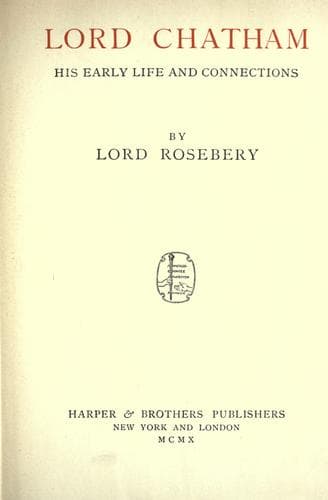
Lord Chatham, His Early Life and ConnectionsRosebery, Archibald Philip Primrose, Earl of
History
Lord Chatham, His Early Life and Connections
Rosebery, Archibald Philip Primrose, Earl of
Pitt, William, Earl of Chatham, 1708-1778
In February 1745 a question arose of peculiar delicacy for Pitt. Through
one of the compromises sometimes required by political emergency the
question of the employment of the Hanoverians, against which Pitt was so
strongly pledged, was arranged by transferring them to Maria Theresa,
with an extra subsidy to enable her to pay them. This somewhat
transparent artifice was boldly and dexterously defended by Pitt
himself. On such occasions it is well not to hesitate or refine, and
Pitt spoke without visible qualms. 'It was,' he said, 'a meritorious and
popular measure, which did honour to the minister who advised it, and
the Prince, who so graciously vouchsafed to follow it, and must give
pleasure to every honest heart. As to what had been thrown out that the
Queen of Hungary might take them into her pay, when they were dismissed
from ours, what of that? She was at liberty to take them or not. They
would not be forced on her, but God forbid that these unfortunate troops
should by our votes be proscribed at every court in Europe.' It was
enough that, 'by his Majesty's wisdom and goodness,' they were no longer
voted annually as a part of our army, and so forth.[168]
It is obvious from the meagre report that Pitt was now as copious in his
praise of the King as he had formerly been niggard. His Sovereign had
become wise and good and gracious; the Hanoverian troops, which had been
so short a time ago cowardly and contemptible troops, were now
unfortunate and meritorious, well worthy the attention and employment of
Maria Theresa. One or two members could not help smiling; they called
the measure collusive, and declared that if we were to pay the
Hanoverians at all it were better to pay them directly, when they would
at least be under our direction and control, than through the Queen of
Hungary, when they would not. It is not on record that any one asked
what advantage would be reaped by the taxpayer under the method
proposed, when he would pay at least as much as before, but without the
least check as to the way in which the money was spent. Nevertheless,
there were complaints enough. Pitt must have hinted that it was better
that they should fight under the Hungarian flag than the British, as
they did not fight in harmony by the side of British troops; for this
called up a Northumbrian baronet to explain that this was contrary to
the fact, and that he should raise the point in a motion. Pitt at once
rose again, not in his high line, but 'with all the art and temper
imaginable,' soothed and complimented the honest member, hinted that his
motion would only serve the purposes of Carteret, whom they both
rejoiced to see removed, and generally allayed the debate with complete
success.[169]
This is again a notable mark in his career. For the first time he
appears, not as the fierce hero of declamation and invective, but as the
dexterous official diplomatist, coaxing and reassuring. He was fast
moving onwards.
Public-domain text, read in full here on John Shaqi.
Reviews
Reviews
No reviews yet
Be the first to share your thoughts on this work.
Elsewhere in the archive
Join the Discussion
Join the discussion
Sign in to leave a comment or review.
Sign InorCreate an account