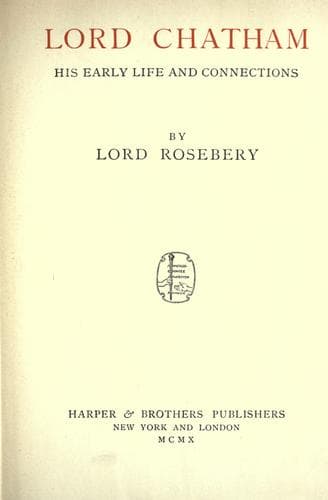
Lord Chatham, His Early Life and ConnectionsRosebery, Archibald Philip Primrose, Earl of
History
Lord Chatham, His Early Life and Connections
Rosebery, Archibald Philip Primrose, Earl of
Pitt, William, Earl of Chatham, 1708-1778
But Charles contented himself with a reign at Holyrood of six weeks, and
this delay lost him his chances of success. When Parliament met on
October 17 he was still in Edinburgh, but adequate measures had been
taken to render his enterprise abortive. All this does not concern Pitt,
except as giving him an opportunity of expressing his devoted loyalty to
George II.; but while Charles Edward was marching on Derby a desperate
struggle was going on which related entirely to him. In the new session
he had begun to show signs of irritation and of impatience with the
Government; the emollients of the Pelhams began to lose their virtue,
and he was determined not to be fooled any longer. His amiability had
disappeared, and though his speeches are unreported, it is evident that
the Ministers were now made to feel the terrors of his tongue.
'Yesterday,' writes Horace Walpole, 'they had another baiting from Pitt,
who is ravenous for the place of Secretary at War: they would give it
him: but as preliminary, he insists on a declaration of our having
nothing to do with the Continent,' a stipulation which reads strangely
enough by the light of the years to come. The Pelhams saw that they
could no longer defer the fulfilment of their promises, and that it was
necessary to approach the King. The moment was singularly unfavourable.
The King had never forgiven the compulsion put on him to dismiss
Carteret, nor the fact of his separation from Carteret. He had
shrewdness enough to see that in ability and grasp of affairs Carteret
towered above the other ministers except the Chancellor; and he despised
Newcastle, who was principally thrown into contact with him. It was a
shame, he declared, that a man who was not fit to be a chamberlain at
the pettiest of German courts should be forced on the nation and on the
Crown as a principal minister. All through 1745 the royal resentment
smouldered, though it was kept in suspense by the rebellion. But when
that movement lost in importance and became clearly doomed, the King
felt more free to display his feelings. Foreign policy, with which we
are not here concerned, was part of his grievance; but the main cause of
irritation was the threatened intrusion of Pitt on his councils. And yet
this was obviously impending and even inevitable. Pitt, at first so
patient, had begun to show his teeth in public, and probably in private
as well. The crisis could not be any longer avoided.
Public-domain text, read in full here on John Shaqi.
Reviews
Reviews
No reviews yet
Be the first to share your thoughts on this work.
Elsewhere in the archive
Join the Discussion
Join the discussion
Sign in to leave a comment or review.
Sign InorCreate an account