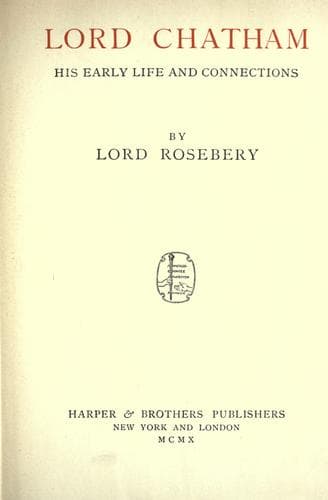
Lord Chatham, His Early Life and ConnectionsRosebery, Archibald Philip Primrose, Earl of
History
Lord Chatham, His Early Life and Connections
Rosebery, Archibald Philip Primrose, Earl of
Pitt, William, Earl of Chatham, 1708-1778
There is something profoundly melancholy in Fox's degeneracy. Its
commencement is clearly marked. In 1756 he was an easy companion, a good
friend, kindly and beloved; he was honoured and admired; he was the
second man in the House of Commons, willing and able to dare all. But
when he was discarded, and had subsided into the Paymastership, he seems
to have suffered a gradual deterioration. His objects became sordid; he
lost the finer elements of his character; his ambition sank into
something composed of vindictiveness and greed; his generous wine became
corked and bitter. But at the time we are writing of, he was still
amiable, still courageous, still warm with some instinct of honour,
patriotism, and high emulation, still an able and masculine figure. It
is perhaps unfair to anticipate a decline which is outside our limits.
But the change is so remarkable, throwing, as it were, a back light on
some of the puzzling aspects of Fox's earlier career, that it cannot
well be unnoticed.
More ominous of Pitt's attitude to the Ministry than any small incidents
of debate was Pitt's silence. For three successive sessions of
Parliament, in 1752, 1753, and in that which closed in April 1754, he
practically held his peace. Nothing could be more sinister, nothing
could mark more emphatically his discontent. Sickness, it appears,
accounted in part for this abstinence from the arena. 'After a year of
sullen illness,' as Horace Walpole describes it, he intervened in 1753;
and this was followed by another twelve months of silence and of illness
not less sullen. The intervention of 1753 was not very happy. By an Act
passed in June 1753, foreign Jews had been rendered capable of
naturalisation. The Bill had passed into law without serious opposition,
but soon aroused great popular clamour. Grub Street, as usual, was
called into requisition.
'But Lord! how surprised when they heard of the news
That we were to be servants to circumcised Jews,
To be negroes and slaves instead of True Blues,
Which nobody can deny.'
Newcastle was charged with having been bribed.
'That money you know is a principal thing,
It will pay a Duke's mortgage or interest bring.'[205]
[Sidenote: Nov. 27, 1753.]
Public-domain text, read in full here on John Shaqi.
Reviews
Reviews
No reviews yet
Be the first to share your thoughts on this work.
Elsewhere in the archive
Join the Discussion
Join the discussion
Sign in to leave a comment or review.
Sign InorCreate an account