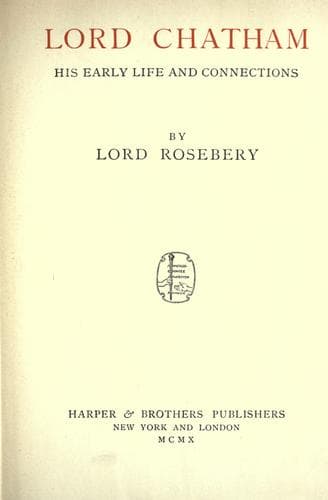
Lord Chatham, His Early Life and ConnectionsRosebery, Archibald Philip Primrose, Earl of
History
Lord Chatham, His Early Life and Connections
Rosebery, Archibald Philip Primrose, Earl of
Pitt, William, Earl of Chatham, 1708-1778
But words cost little, and Pitt did not disdain profusion in them any
more than in what cost more. In a letter to Lyttelton written
immediately after Pelham's death, when he recommended an attitude of
armed and hostile vigilance towards the new powers, he says:
'Professions of personal regard cannot be made too strongly,' and this
line of conduct explains his professions to Newcastle. For how could he
fail under existing circumstances to be suspicious? Had Newcastle lifted
a finger to procure him the succession to Bedford? Yet no one could
compete in Parliamentary authority with Pitt; and, though Murray's
claims to oratorical pre-eminence might vie with his, Murray's
aspirations were confined to the law. At this time, Chesterfield, the
best living judge of such matters, was writing to his son, and
expressing therefore his real convictions: 'Mr. Pitt and Mr. Murray are
beyond comparison ... the best orators. They alone can inflame or quiet
the House; they alone are so attended to, in that numerous and noisy
assembly, that you might hear a pin fall while either was
speaking.'[211] It is true that Chesterfield depreciates Pitt's matter.
But the fact remains that he mentions Pitt as one of the two supreme
masters of the House of Commons, the other, indeed, not having much
heart in politics. The ignoring, the slighting of this great power,
could not be forgiven by so aspiring a nature as Pitt's. He brooded and
watched.
CHAPTER XIV.
How did he pass these three years? It is not easy to say, for we have so
little light on his private life. No prescient Boswell marked his words
and habits, or indeed had much opportunity of doing so. Few men of the
same eminence have lived in such retirement as he did; we only catch
glimpses. In the first place, it may be said without extravagance that
his principal occupation was the gout. His gout became part of the
history of England. To him it was a cruel fact. It kept him constantly
disabled, and constantly away from London, ever trying new waters,
principally the historical springs of Bath. Bath, indeed, was his second
home. He seems to be almost always there till his marriage, and very
frequently afterwards. Half his letters seem to be dated thence. At last
he definitely recognised it as a home by building a house there in the
Circus, which cost him 1200_l._[212] This was in 1753. But in 1763 he
disposed of this particular house, probably under some financial
stress.[213] Whether he thus established himself from love of the place
or from love of his friend Ralph Allen, who was Fielding's Squire
Allworthy and Bath's Man of Ross, or whether he had already an ambition
to represent the City in Parliament, we cannot tell. His cousin, Lord
Stanhope soon joined him and bought the houses next to his.[214] As time
went on, and Pitt's fame and seclusion increased, it became more and
more a political centre. There men collected who were anxious to get a
Public-domain text, read in full here on John Shaqi.
Reviews
Reviews
No reviews yet
Be the first to share your thoughts on this work.
Elsewhere in the archive
Join the Discussion
Join the discussion
Sign in to leave a comment or review.
Sign InorCreate an account