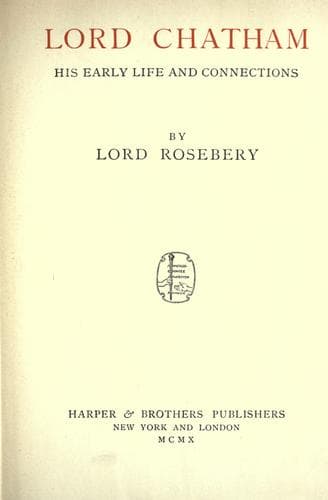
Lord Chatham, His Early Life and ConnectionsRosebery, Archibald Philip Primrose, Earl of
History
Lord Chatham, His Early Life and Connections
Rosebery, Archibald Philip Primrose, Earl of
Pitt, William, Earl of Chatham, 1708-1778
He died on March 6, and the news found Pitt, on March 7, crippled and
immovable at Bath. His feet were impotent with gout, but his brain and
hands were evidently unaffected. He at once despatched a brief note of
condolence to Newcastle, 'whose grief must be inconsolable as its cause
is irreparable. You have a great occasion for all your strength of mind
to exert itself. Exercise it for the sake of your master and your
country, and may all good men support you. I have the gout in both feet
and am totally unable to travel.'[228] To Lyttelton and the Grenvilles
he wrote on the same day at length 'the breaking of first thoughts to be
confined to you four,'[229] enclosed in a covering letter to Temple,
saying that he was worn down with pain, and incapable of motion. But he
was none the less vigilant with regard to the least ripple on the
surface of politics, 'I heard some time since that the Princess of Wales
inquired after my health: an honour which I received with much pleasure,
as not void, perhaps of some meaning.'[230] Newcastle at once answered
Pitt's note of condolence, for we find Pitt acknowledging the reply on
March 11, and mentioning a letter written to him by Hardwicke, under
Newcastle's authority, 'with regard to some things in deliberation for
the settling the Government in the House of Commons and the direction of
the affairs of the Treasury. My answer is in a letter to Sir George
Lyttelton.'[231] This was practically giving powers to Lyttelton to
negotiate with Newcastle as Pitt's representative; a strange choice,
when we read in the covering letter to Temple: 'let me recommend to my
dear Lord to preach prudence and reserve to our friend Sir George, and,
if he can, inspire him with his own.' Lyttelton indeed was not destined
ever to earn fame as a negotiator.
And now it is necessary to give the principal passages of this letter to
Lyttelton and the Cousinhood, which would have been a fuller and clearer
manifesto had not all politicians at that time felt a well-grounded
apprehension that their letters would be opened and read before they
were delivered. Fulness and clearness were therefore the last qualities
aimed at in their epistolary style, and inquiring posterity rues the
result.
MR. PITT TO SIR GEORGE LYTTELTON AND THE GRENVILLE BROTHERS.
_March 7, 1754._
Public-domain text, read in full here on John Shaqi.
Reviews
Reviews
No reviews yet
Be the first to share your thoughts on this work.
Elsewhere in the archive
Join the Discussion
Join the discussion
Sign in to leave a comment or review.
Sign InorCreate an account