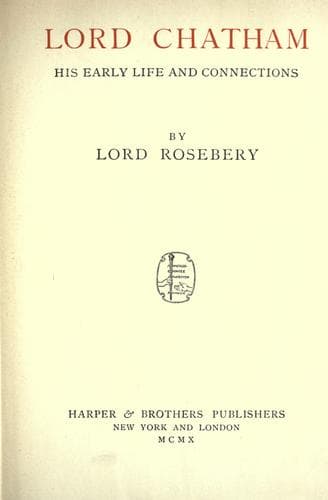
Lord Chatham, His Early Life and ConnectionsRosebery, Archibald Philip Primrose, Earl of
History
Lord Chatham, His Early Life and Connections
Rosebery, Archibald Philip Primrose, Earl of
Pitt, William, Earl of Chatham, 1708-1778
This letter was enclosed to Lyttelton under flying seal to be
communicated to the Grenvilles. Pitt, writing the same day to Temple,
says: 'I hope my letter to the Duke of Newcastle will meet with the
fraternal approbation. It is strong, but not hostile, and will, I
believe, operate some effect. I am still more strongly fixed in my
judgement that the place of importance is employment, in the present
unsettled conjuncture. It may not to us be the place of dignity, but
sure I am it is that of the former. I see, as your Lordship does, the
treatment we have had: I feel it as deeply, but I believe, not so
warmly. I don't suffer my feelings to warp the only plan I can form that
has any tendency or meaning. For making ourselves felt, by disturbing
Government, I think would prove hurtful to the public, not reputable to
ourselves, and beneficial in the end, only to others. All Achilles as
you are, Impiger, Iracundus, etc., what would avail us to sail back a
few myrmidons to Thessaly! Go over to the Trojans, to be revenged, we
none of us can bear the thought of. What then remains? The conduct of
the much-enduring man, who by temper, patience, and persevering
prudence, became _adversis rerum immersabilis undis_.'
He adds another postscript of caution: 'Be so good as not to leave my
letters in your pockets, but lock them up or burn them, and caution Sir
George to do the same.'[241] Secrecy was of the essence of his scheme.
Should Newcastle or the Chancellor understand the part that he designed
to play, they would have an advantage in the game.
On April 2 Pitt writes to jog Newcastle's memory in a note about the
Aldborough election: 'I had expected to hear from you, but I know the
multiplicity of your business.'[242] He need not have feared that his
letter had been overlooked. So little was this the case that, no doubt
after anxious and protracted conferences, Newcastle and Hardwicke were
both writing to him on this very day long and elaborate apologies.
Hardwicke's is a document, as might be expected, of great but inadequate
skill.[243] It gives him much concern to find that Pitt is 'under
apprehensions of _some_ neglect on this decisive occasion.' He is not
altogether surprised. Could Pitt only have heard how warmly Hardwicke
pressed his claims! But there are certain things which ministers cannot
do directly. These must be left to 'time and incidents and perhaps
ill-judging opponents.' Fox's pressing for larger powers than the King
would give had no doubt helped the cause of Pitt, and Newcastle's being
at the head of the Government whose devotion to Pitt was so notorious
would further it still more. He concludes by hoping with sincerity that
Pitt would take an active part, though no doubt had he seen the
direction in which his wish was fulfilled, he would have withdrawn it
with greater emphasis. This stripped of verbiage seems the bone of this
long letter.
Public-domain text, read in full here on John Shaqi.
Reviews
Reviews
No reviews yet
Be the first to share your thoughts on this work.
Elsewhere in the archive
Join the Discussion
Join the discussion
Sign in to leave a comment or review.
Sign InorCreate an account