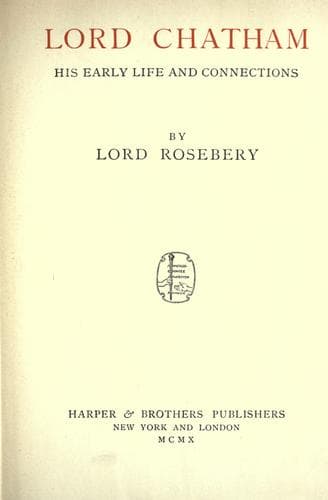
Lord Chatham, His Early Life and ConnectionsRosebery, Archibald Philip Primrose, Earl of
History
Lord Chatham, His Early Life and Connections
Rosebery, Archibald Philip Primrose, Earl of
Pitt, William, Earl of Chatham, 1708-1778
Newcastle cared little for the charge of breach of faith. He had kept
his patronage, and, as he thought, silenced Fox, who remained Secretary
at War. In a hysterical condition he hurried to kiss hands for his new
office. He flung himself at the King's feet, sobbing out 'God bless your
Majesty! God preserve your Majesty!' embracing the royal knees with such
howls of adoration that the lord-in-waiting had to beg the other
courtiers to retire and not watch 'a great man in distress;' then, in
the zeal of discretion, attempting to shut the door on the tittering
crowd, he jammed the new Minister's foot till genuine roars of physical
pain drowned the more artificial clamour.[254] Having recovered himself
after this characteristic performance, Newcastle betook himself without
delay to the choice of his heart, the man whom he had always longed for
as a colleague, even at the time when he had been seeking a successor to
Bedford, an obscure diplomatist, Sir Thomas Robinson. 'Had I,' he had
written in September 1750, 'to chuse for the King, the public, and
myself, I would prefer Sir Thomas Robinson to any man living. I know he
knows more and would be more useful to the country and me than any other
can be.' This opinion seems to have been confined to the Duke himself.
Horace Walpole writing at the moment says:--'The German Sir Thomas
Robinson was thought on for the Secretary's seals; but has just sense
enough to be unwilling to accept them under so ridiculous an
administration. This is the first act of the comedy.' But in the second
act Sir Thomas's good sense was unequal even to this strain, and he
accepted the post. Under what hallucination he laboured, or whether he
was merely beguiled by the fawning caresses of Newcastle, it is
difficult to say. The fact remains that he undertook to lead the House
of Commons, seated between Pitt and Fox, whom he knew to be malcontents,
and capable of anything. His own parliamentary powers were in the egg
(for he had never spoken), and were never destined to be hatched. At the
time of his appointment as Secretary of State he was Master of the Great
Wardrobe, a congenial post which he was destined during the next year to
resume. For in his new capacity he justified the anticipations of his
enemies, and disturbed the equanimity of his friends. Newcastle himself
had recommended the appointment to Pitt's benevolent consideration on
the very ground that he could not excite the rivalry of existing
orators. He 'had not those parliamentary talents which could give
jealousy or in that light set him above the rest of the King's
servants.' But the reality was far below these modest anticipations. Sir
Thomas was not merely ineffectual and feeble, but would attempt on
occasion agonising flights of eloquence. Posterity is spared the perusal
of these, for Parliamentary history records no word of this unhappy
leader. 'Sir Thomas,' says Lord Waldegrave, 'though a good Secretary of
Public-domain text, read in full here on John Shaqi.
Reviews
Reviews
No reviews yet
Be the first to share your thoughts on this work.
Elsewhere in the archive
Join the Discussion
Join the discussion
Sign in to leave a comment or review.
Sign InorCreate an account