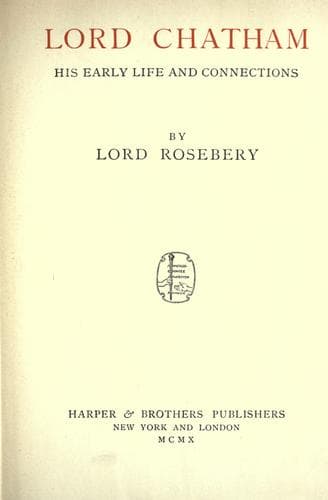
Lord Chatham, His Early Life and ConnectionsRosebery, Archibald Philip Primrose, Earl of
History
Lord Chatham, His Early Life and Connections
Rosebery, Archibald Philip Primrose, Earl of
Pitt, William, Earl of Chatham, 1708-1778
He must have felt
that there were menacing symptoms in the political horizon. It is
strange, therefore, to find Walpole writing that, as 'Newcastle had
secured by employments almost every material speaker in Parliament,' it
was hoped that the session might pass in settling election
petitions.[268]
It seems incredible that the Duke can have so flattered himself. But no
doubt he relied on two main considerations. One was that, though
official discipline was then incomparably more lax than now, it was
scarcely possible for Pitt or Fox to mean mischief so long as they kept
their places, and these they had not resigned. The other was this. The
General Election had just been conducted under his auspices, and had
returned a House of Commons devoted to himself. Indeed in all England
there were only forty-two contests. In some Continental countries a
general election always returns a ministerial majority; there are
mysteries connected with the proceeding of which only ministers have the
key. This to some extent was the case in England at this period; and no
Secretary of the Treasury, no Martin or Robinson, understood his
particular business better than Newcastle. But whatever his illusions,
they were soon destined to be disturbed, for on November 25 Pitt opened
fire on him. Of that famous scene and outburst we are fortunate enough
to possess two brilliant descriptions: one by Horace Walpole, and one,
even more graphic, which has the additional value of being written by
Pitt's rival, Henry Fox. Fox, writing in a white heat of generous
admiration, describes it summarily as 'the finest speech that ever Pitt
spoke, and perhaps the most remarkable.' This last epithet was probably
due to the fact that the speech was apparently made on the spur of the
moment. The occasion was one of those election petitions on which the
Duke had relied as a sedative and a pastime for his faithful Commons.
Wilkes, the pleasant, worthless demagogue, who was afterwards to cause
so much trouble, had petitioned against the return of Delaval, the
sitting member for Berwick. Delaval had defended his seat in a speech
full of wit and buffoonery, which kept the House in a roar of laughter;
much the same speech, one would guess, that Pitt himself had delivered
on the proceedings at his own election for Seaford when those were
attacked. But to-day he was in a different mood, and, as the debate
proceeded, came down from the gallery where he was seated, and
intervened with a frown. He was 'astonished to hear this merriment when
such a matter was concerned. Was the dignity of the House on so sure a
foundation that we could afford to shake it with scoffs?' In an instant
the House was cowed into silence, like schoolboys found in fault by
their master. You could have heard a pin drop as he continued.
Public-domain text, read in full here on John Shaqi.
Reviews
Reviews
No reviews yet
Be the first to share your thoughts on this work.
Elsewhere in the archive
Join the Discussion
Join the discussion
Sign in to leave a comment or review.
Sign InorCreate an account