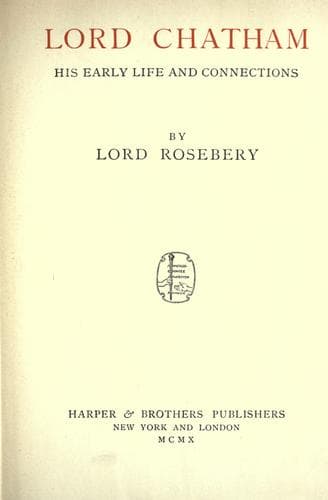
Lord Chatham, His Early Life and ConnectionsRosebery, Archibald Philip Primrose, Earl of
History
Lord Chatham, His Early Life and Connections
Rosebery, Archibald Philip Primrose, Earl of
Pitt, William, Earl of Chatham, 1708-1778
This surely was no inordinate claim from indisputably the first member
of the House of Commons, whom the King had kept at bay for so many
years, and to keep whom still in subjection every possible manoeuvre,
childish or cunning, was being adopted. 'Why,' said he bluntly to
Newcastle, 'cannot you bring yourself to part with some of your sole
power?' This of course produced voluble asseverations from the Duke.
Sole power! What an idea! He had no conception of what Pitt could mean.
He was in his present place, not by his own choice, far from it! but by
the King's command, and, though he was devoted to the King, he would
retire to-morrow if he was distasteful to the House of Commons. (This
was a safe promise, for, as we have seen, the House of Commons was with
but few exceptions at his absolute disposal.) Pitt replied that he
himself had no objections to a Peer as First Lord of the Treasury, but
there must be men of ability and responsibility in the House of Commons,
a Secretary of State and a Chancellor of the Exchequer, that they must
be sufficiently supported, and they must have access to the Crown, not a
nominal, but an habitual, free, familiar access. In speaking of the
Chancellor of the Exchequer he burst out into so enthusiastic a eulogy
of Legge, 'the child, and deservedly the favourite child of the Whigs,'
that Newcastle suspected that all this was concerted between his
rebellious Chancellor of the Exchequer and his insubordinate Paymaster.
Pitt and the Duke next proceeded to analyse their own expressions; a
task which the statesmen of that day seem to have avoided, to our
detriment, as much as possible. Newcastle had spoken of the proposed
seat in the Cabinet as a designation. 'What did this mean?' asked Pitt.
'Did it mean the seals of Secretary of State, though not immediately?'
The Duke was obliged to shuffle out, for in truth he had no power to
promise any such thing. Designation only meant that the seat in the
Cabinet would design him as the King's man of confidence. 'Then the
Secretaryship of State is not intended,' was the fierce rejoinder. The
Duke replied that he was not authorised to offer more than a seat in the
Cabinet. If, rejoined Pitt, 'the Secretaryships of State are to remain
as they are, there is an end of any question of my giving active support
to the Government in the House of Commons.'
Public-domain text, read in full here on John Shaqi.
Reviews
Reviews
No reviews yet
Be the first to share your thoughts on this work.
Elsewhere in the archive
Join the Discussion
Join the discussion
Sign in to leave a comment or review.
Sign InorCreate an account