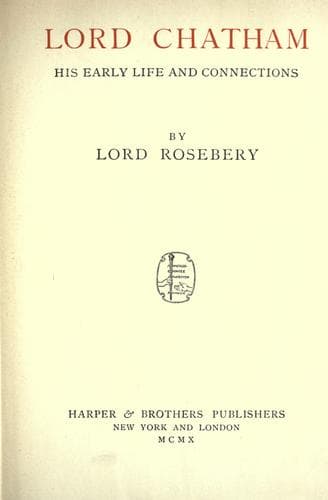
Lord Chatham, His Early Life and ConnectionsRosebery, Archibald Philip Primrose, Earl of
History
Lord Chatham, His Early Life and Connections
Rosebery, Archibald Philip Primrose, Earl of
Pitt, William, Earl of Chatham, 1708-1778
Hardwicke made one last desperate effort to move Pitt, but without
success. He writes to Newcastle on September 15 (1755): 'I have had a
long conversation with the _gentleman_ your Grace knows, but with little
effect. I talked very fully and strongly to him upon every part of the
case, both as to _persons_ and _measures_. He made great professions of
his regard and firm attachment to your Grace and me, but adhered to his
_negative_. He puts that negative upon two things: His objections to the
two treaties of subsidy ... his other objection arose from _Mr. F._,
with whom he declared he could not act.'[290]
On this scene, coming more and more into prominence as the King became
older, and as the Prince of Wales, or rather Bute and his clique, waxed
bolder, appears the mysterious and elusive influence of Leicester House.
It is difficult to trace or measure this combination, except in the
naked fact of an old King and a young heir, nor is it easy to trace the
connection of Pitt with this party. Every movement in Leicester House
was jealously watched by the politicians, much as a late Sultan is said
to have tracked the movements of the least menial of his dethroned and
secluded predecessor. We read of the Princess being stirred to wrath by
her father-in-law's project of marrying her son to the daughter,
supposed to be active and ambitious, of a woman she detested. Then there
is the suspicion that the Heir Apparent was surrounded by persons who
were more or less Jacobite; Bute himself having, it was presumed,
Jacobite leanings. But the King at once desisted with rare good sense
from any idea of the projected marriage, though no doubt it would have
given him pleasure. And the danger of an Hanoverian sovereign becoming a
Jacobite under any influence seems too fantastic for a pantomime. The
real apprehension was no doubt that Leicester House might shake off the
domination and destroy the long monopoly of the Whigs, as indeed it
eventually did. And certainly Leicester House, with the throne full in
view, was becoming more and more inclined to assert itself. Human nature
and family relations had, as usual in such cases, much to do with the
matter. The Hanoverian Kings did not love their heirs apparent. George
the First hated his, but he had no other son to love, and indeed little
capacity for loving, except mistresses who found favour with no one
else. George the Second hated his with a peculiar hatred, and was thus
able to devote what fatherly affection he had to give to his second son,
the Duke of Cumberland. These parental preferences, however justifiable,
do not tend to affection between sons. And so there was no love lost
between Prince Frederick and his family on the one side, and Duke
William on the other. These feelings, as is usually the case, survived,
when Frederick died, with increasing intensity between the widow and her
brother-in-law. She saw him on the right hand of the King, enjoying all
Public-domain text, read in full here on John Shaqi.
Reviews
Reviews
No reviews yet
Be the first to share your thoughts on this work.
Elsewhere in the archive
Join the Discussion
Join the discussion
Sign in to leave a comment or review.
Sign InorCreate an account