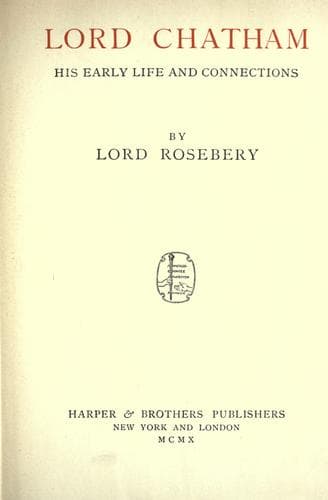
Lord Chatham, His Early Life and ConnectionsRosebery, Archibald Philip Primrose, Earl of
History
Lord Chatham, His Early Life and Connections
Rosebery, Archibald Philip Primrose, Earl of
Pitt, William, Earl of Chatham, 1708-1778
But apart from the perfidious ambitions of governments and the predatory
lusts of savages, there could not be peace in America, nor in effect had
there been since the settlement of Utrecht. Boundaries in that trackless
continent were vague, and constantly overstepped. The proper limits of
Nova Scotia, and the demarcation between Canada and New England, were
subjects of acute controversy. Under such circumstances both parties
plant outposts in disputed territories, and both attempt to dislodge
each other. French officers headed exploring parties, annexing vast
territories by the simple expedient of nailing to a tree-trunk a tin
plate stamped with the arms of France, and burying at the root a leaden
tablet recording that possession had thus been taken. But there were
other operations much less bloodless and futile. One of these petty
engagements survives in history because it marks the first appearance of
Washington, compelled in 1754 to celebrate the Fourth of July by a
surrender to the French, who had surrounded him in superior numbers; and
because it was the commencement of open but not declared warfare between
the British and the French. Both nations now determined to send out
reinforcements. 'In a moment,' says Walpole, 'the Duke of Newcastle
assumed the hero, and breathed nothing but military operations; he and
the Chancellor held councils of war; none of the ministers except Lord
Holderness were admitted inside their tent.' With some discount for
Walpole's malicious pleasantry, the picture, humorous enough to us, must
have filled men like Pitt with the darkest misgivings. Pitt, as we have
seen, had once been accidentally admitted into the tent and taken into
confidence. He must have left it with the feeling that the destinies of
the Empire were in peril so long as Newcastle was at the helm. A giant
conflict for the supremacy of the world was preparing, and Newcastle was
in charge of Great Britain. It was enough to give the bravest patriot a
qualm. Nor were the military preparations less deplorable. Braddock was
sent out at the new year with a plan of campaign prepared by
Cumberland. Cumberland on Braddock was a combination which might make
the stoutest heart in England quail. Cumberland, who had lost every
battle but the one-sided affray of Culloden, was the brain to devise.
Braddock, a brutal soldier of parade experience, whose only warfare had
been in Hyde Park or Hounslow, was the hand to execute. Braddock took
his troops through the American bush as if they were marching from
London to Windsor, and was annihilated ten miles from the French
stronghold, Fort Duquesne, where now smokes toiling Pittsburg. British
troops then first faced the most formidable of adversaries, an invisible
foe. They advanced boldly, cheering and singing 'God save the King.' But
they found that they were mere targets for a host of concealed
sharpshooters. Behind every tree and rock there lurked a musket. At last
they broke ranks and huddled into confusion.
Public-domain text, read in full here on John Shaqi.
Reviews
Reviews
No reviews yet
Be the first to share your thoughts on this work.
Elsewhere in the archive
Join the Discussion
Join the discussion
Sign in to leave a comment or review.
Sign InorCreate an account