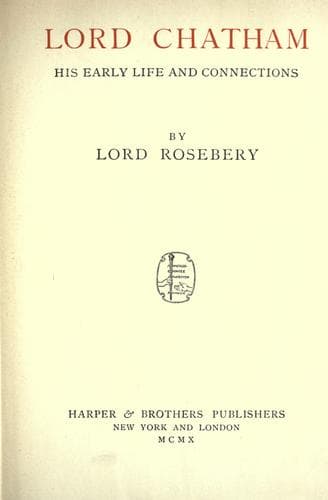
Lord Chatham, His Early Life and ConnectionsRosebery, Archibald Philip Primrose, Earl of
History
Lord Chatham, His Early Life and Connections
Rosebery, Archibald Philip Primrose, Earl of
Pitt, William, Earl of Chatham, 1708-1778
On September 15, George II. deigned to return to his British dominions,
and on November 13 he opened his Parliament. Two circumstances were
considered noteworthy in connection with the formal occasion. Fox, as
leader of the House, rehearsed the Speech from the Throne, as was then
the custom, at the Cockpit; but the Chancellor of the Exchequer, the
Paymaster, and the Grenvilles were conspicuous by their absence. Fox,
too, summoned his supporters by a note of the kind then, as now,
customary, but in terms which gave offence to the susceptible
independence of members; intimating that the King was about to make him
Secretary of State, though not till after the first debate, 'which may
be a warm one,' so that his seat might not be vacated until after the
Address had been voted. He was also to take upon him 'the conduct of the
House of Commons.' This last expression was animadverted upon in
Parliament, and Fox admitted that he should have said 'conduct of His
Majesty's affairs in the House of Commons.' In these days, when 'leader
of the House of Commons' is the recognised title of the principal
Minister in the House, it is not without interest to notice this
constitutional squeamishness.
The King's Speech contained the following paragraph, which strikes the
reader as something less than candid:--
'With a sincere desire to preserve my people from the calamities of war,
as well as to prevent, in the midst of these troubles, a general war
from being lighted up in Europe, I have always been ready to accept
reasonable and honourable terms of accommodation; but none such have
hitherto been proposed on the part of France. I have also confined my
views and operations to hinder France from making new encroachments, or
supporting those already made; to exert our right to a satisfaction for
hostilities committed in a time of profound peace: and to disappoint
such designs as, from various appearances and preparations, there is
reason to think, have been formed against my kingdoms and dominions.'
Members met to hear the Royal Speech in the electric condition which
bodes a crisis. There had been a long political truce; but this was
evidently about to come to an end. Ministers had to bear the burden of
the Russian and Hessian treaties, which the Speech from the Throne
commended to the attention of Parliament. War with France was impending;
indeed, a French invasion was daily expected. There was a new leader,
and, consequently, a new opposition. Pitt was evidently prepared to
launch thunderbolts at the Administration. Leicester House was said to
be behind him. There was an animating sense of conflict in the air.
Once more the parliamentary history fails us, and disdains to record one
of the most memorable passages in its annals; so once more we are thrown
on the authority and the sketches of Walpole; sometimes brilliant, but
more often confused and defective.
The debate in the Commons lasted till near five in the morning, an hour
then almost unprecedented.
Public-domain text, read in full here on John Shaqi.
Reviews
Reviews
No reviews yet
Be the first to share your thoughts on this work.
Elsewhere in the archive
Join the Discussion
Join the discussion
Sign in to leave a comment or review.
Sign InorCreate an account