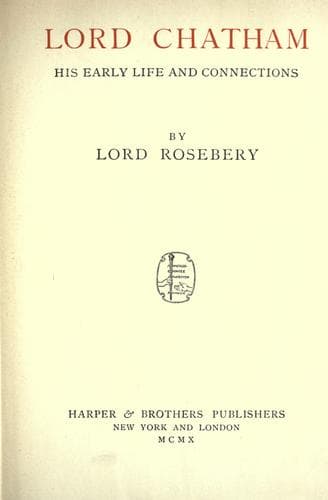
Lord Chatham, His Early Life and ConnectionsRosebery, Archibald Philip Primrose, Earl of
History
Lord Chatham, His Early Life and Connections
Rosebery, Archibald Philip Primrose, Earl of
Pitt, William, Earl of Chatham, 1708-1778
not sufficient. Next day he must write again to say to Lord Temple,
'that I am more yours than my own, and that I equally love and revere
the kindest of brothers and the noblest of men.'
Language less ecstatic would better have become a great man accepting a
serious pecuniary obligation. In truth Pitt never had any scrupulous
idea of personal independence. He had accepted a borough from Newcastle,
whom he then suspected and despised. Now it was an allowance from
Temple, whom, from close intimacy and kinship, he must have known to be
an intriguing politician, who was not likely to give without expecting
return. A few years hence it was to be a pension from the Crown.
With regard to money indeed he had no very careful or exalted standard.
In such matters he was indifferent, reckless, and heedless of any nicety
of scruple, except as regards the public. He never seems to have
considered how important solvency is to character. He was always, after
his marriage, quite unnecessarily, in desperate straits for money.
Indifference to the fact that pecuniary independence is a main though
not necessary base of moral independence was a flaw in his own life, and
was the worst inheritance that he transmitted to his illustrious son.
The announcement of Legge's successor at the Exchequer provoked
universal hilarity. It was Lyttelton. We have seen that in the last
debate Pitt had turned with fierce scorn on his former ally. No doubt he
was aware of Lyttelton's approaching elevation. But their historic
friendship had been dissolved for a year. In November 1754, at the
heedless or mischievous instance of the younger Horace Walpole,
Lyttelton, with the best intentions and the most inane execution
possible, had hurried off, without consultation with his friend, to
effect a reconciliation between Newcastle, Pitt's enemy, and Bedford,
who was allied to Pitt by a common hatred of the Minister. Newcastle
received the negotiator with his wonted effervescence, and gave or
appeared to give full powers. Away sped Lyttelton, bursting with the
importance of an amateur diplomatist. But at the mere mention of his
mission the other Duke nearly kicked the messenger of peace downstairs,
and at once communicated the secret overture to Pitt. The result to
Lyttelton was for the moment unmixed disaster. Pitt publicly broke with
him, Newcastle of course disowned him, he indeed disowned himself.
Henceforth he was banned by the Cousinhood, and incurred a wrath and
vengeance as implacable as that of the Carbonari. Now, however, he had
his reward, for it can scarcely be doubted that his elevation to the
Exchequer was intended partly as a plaster for his diplomatic wounds,
partly as an annoyance to the party of Pitt. Any motive indeed but
fitness for the office can be suggested for his promotion, to which he
was lured by the promise of a peerage.[306] If, however, the annoyance
it would cause to his late friends was a reason, it failed in its
object.
Public-domain text, read in full here on John Shaqi.
Reviews
Reviews
No reviews yet
Be the first to share your thoughts on this work.
Elsewhere in the archive
Join the Discussion
Join the discussion
Sign in to leave a comment or review.
Sign InorCreate an account