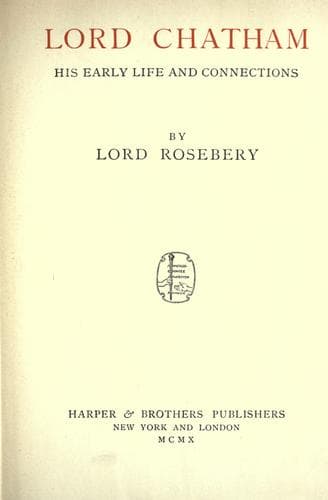
Lord Chatham, His Early Life and ConnectionsRosebery, Archibald Philip Primrose, Earl of
History
Lord Chatham, His Early Life and Connections
Rosebery, Archibald Philip Primrose, Earl of
Pitt, William, Earl of Chatham, 1708-1778
So slight had been the defence, said Pitt, that he did not know how to
deal with it; only little shifts or evasions worthy of a pie-poudre
court, but not of Parliament. As for Hume Campbell, he had him in his
power, he could bring him to his knees at the bar of the House as a
delinquent for such an assault on the privileges of Parliament. If
members were to be threatened for speaking with freedom of Ministers,
all liberty of debate would be at an end. As he revered the profession
of the law, so he grieved to hear it dishonoured by language that fixed
an indelible blot on him that spoke it. 'Superior' was a word that he
disdained. That hon. gentleman might indeed have his superiors. But he
knew that when sitting, speaking, and voting in his legislative capacity
the King himself was not his superior. And he could assure the hon.
gentleman that such freedom in speaking of ministers was neither
unparliamentary nor unprecedented. For even in the profligate
prerogative reign of James I., when a great duke, as now, monopolised
power, the House of Commons possessed an honest member who dared to call
that duke _stellionatus_, a beast of most hideous deformity, covered
with blurs and blotches and filth, an ideal monster, fouler than exists
in nature. Yet a grave and venerable member of parliament thought this
no unfit comparison for that great duke, who no doubt had his slaves all
about him who called him Superior, yet durst not bring such language
into the House of Commons. And we had then a wretched King who would
have been glad of the assistance of a great lawyer, could he have one to
have threatened a member of parliament for exposing the arbitrary and
pernicious designs that he was carrying on by his ministers against his
people. Thank God! we had no such King. If we had, he would not want a
slavish lawyer to abet the worst measures that can be devised to ruin
and enslave this country.
'But I will not dress up this image under a third person,' he exclaimed,
turning full round and facing Hume Campbell, 'I apply it to him; his is
the servile doctrine; he is the slave; and the shame of his doctrine
will stick to him as long as his gown sticks to his back. After all, his
trade is words; they were not provoked by me, but they have no terrors
for me, they provoke only my ridicule and contempt.'
Then turning to Murray, he denounced the treaties as a violation of the
Act of Settlement. The article to which, it may be presumed, he referred
was as follows:
'That in case the Crown and Imperial Dignity of this realm shall
hereafter come to any person, not being a native of this Kingdom of
England, this nation be not obliged to engage in any war for the defence
of any dominions or territories which do not belong to the Crown of
England without the consent of Parliament.'
Public-domain text, read in full here on John Shaqi.
Reviews
Reviews
No reviews yet
Be the first to share your thoughts on this work.
Elsewhere in the archive
Join the Discussion
Join the discussion
Sign in to leave a comment or review.
Sign InorCreate an account