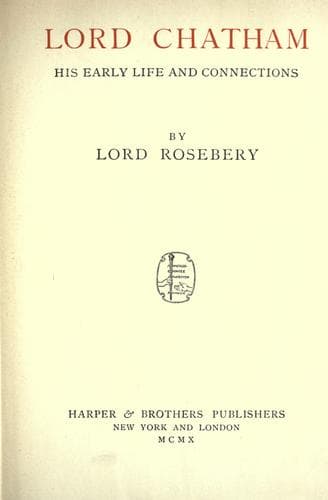
Lord Chatham, His Early Life and ConnectionsRosebery, Archibald Philip Primrose, Earl of
History
Lord Chatham, His Early Life and Connections
Rosebery, Archibald Philip Primrose, Earl of
Pitt, William, Earl of Chatham, 1708-1778
'Not giving succour to Hannibal was indeed wrong, because he was already
on land and was successful, and might have done something of the kind
that Prince Eugene proposed, and marched with a torch to Versailles. But
another poet says, I recollect a good deal of poetry to-day, another
poet says, "Expende Hannibalem," "weigh him, weigh him." I have weighed
him. What good did his glory procure to his country? Remember what the
same poet says: "I, demens, curre per Alpes, ut pueris placeas et
declamatio fias."'
This flight, it may be surmised, was aimed at Cumberland.
He once more expressed his dutiful feelings to the King, and
acknowledged how difficult it was for Ministers to be honest with him.
But yet the resistance to these treaties might save us from a
Continental war. In any case, speaking for himself, he would never again
give his confidence in the nation's advisers or adopters of this
measure. He could only hope that our perverted Ministers might yet yield
to conviction and save us, and that a British spirit might influence
British councils.
In the division which followed, the Hessian treaty appeared somewhat
less acceptable than the Russian. The former was voted by 259 to 72 and
the latter by 263 to 69. This was the net result. Yet, as Horace Walpole
wrote at the time, 'Pitt had ridden in the whirlwind and directed the
storm with abilities beyond the common reach of the genii of the
tempest.' Eloquence, reason, and argument avail little against a compact
parliamentary majority.[317]
The reader will scarcely regret that an adjournment for Christmas
followed this debate, for nothing is so tantalising as these barren
husks of great speeches. The Minister employed his holiday appropriately
in distributing gifts of office to his friends, and the reconstruction
of the Government was completed. No part of it directly touches our
story, but some features are of interest. The Dukes of Newcastle and
Bedford, the Chancellor and Fox were each allowed to nominate a member
of the Board of Trade. But Newcastle would not allow Fox a single voice
in the appointment of the Lords of the Treasury; for he guarded that
department with the jealousy of a Turk. The other point of interest was
the cost to the public of these manipulations. To get rid of Sir Thomas
Robinson it had been necessary to settle a pension on him of 2000_l._ a
year for thirty-one years. To make a place for Lord Hillsborough, Mr.
Arundel had a pension of 2000_l._ in exchange for the sinecure office of
Treasurer of the Chamber. Lord Lothian had 1200_l._ a year to vacate the
Clerk Registership of Scotland for Hume Campbell. Lord Cholmondeley, who
held the Vice-Treasurership of Ireland with one colleague, had 600_l._ a
year to induce him to accept a third partner of the office. Sir Conyers
Darcy had 1600_l._ a year for vacating the Comptrollership of the
Household. In all a burden of 7400_l._ a year was settled on the public
to patch up a feeble and odious Ministry for ten months.
Public-domain text, read in full here on John Shaqi.
Reviews
Reviews
No reviews yet
Be the first to share your thoughts on this work.
Elsewhere in the archive
Join the Discussion
Join the discussion
Sign in to leave a comment or review.
Sign InorCreate an account