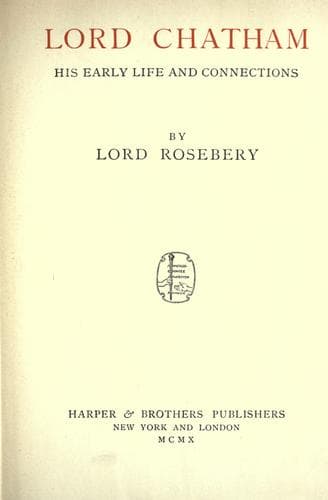
Lord Chatham, His Early Life and ConnectionsRosebery, Archibald Philip Primrose, Earl of
History
Lord Chatham, His Early Life and Connections
Rosebery, Archibald Philip Primrose, Earl of
Pitt, William, Earl of Chatham, 1708-1778
To the King he sent a formal paper of grievance and resignation, which
has already been printed and need not be repeated here. He took great
pains over it, as the drafts testify. The substance of it was that he
had been loyal to Newcastle, but that he had not received support in
return, and so could not carry on the business of Government in the
House of Commons as it should be carried on. But he would gladly serve
the King outside the Cabinet. This meant that he would gladly exchange
offices with Pitt. At the same time he told Cumberland and wrote to
Devonshire that if Newcastle had been such a fool as to offer the seals
to Pitt without knowing whether he would take them, he (Fox), to prevent
the general confusion that would ensue, would continue for another
session. No notice was taken of this offer.[339] It does not seem
certain that it ever reached either Newcastle or the King.
Granville found the King prepared for the resignation, and very angry
with Fox for deserting him. 'Would you advise me to take Pitt?' he
asked. 'Well, Sir!' replied Granville, 'you must take somebody.' 'Ah!
but,' said the monarch, pensively, 'I am sure Pitt will not do my
business.' The business to which the Sovereign referred was, of course,
electoral. He considered that he had in various ways shown Fox great
favour, and that Fox had acted ill in throwing up his office when the
meeting of Parliament was near at hand.
Newcastle received Fox's resignation at the Treasury. Though he was
planning to discard Fox for Pitt, he was thunderstruck at finding that
Fox had anticipated him. He hurried to Court, and found the King in good
humour except with the resigning Secretary. His Majesty gave Newcastle
the paper which he had received from Granville, having underlined the
passage which had mainly offended him: 'for want of support, and think
it impracticable for me to carry on His Majesty's affairs as they ought
to be carried on;' and then recited, with the aid of Newcastle as
prompter, all the favours shown to Fox. But the more urgent and
practical question was not the ingratitude of Fox, but what was to be
done now that he had gone. The King, with that shrewd and redeeming
touch of humour which we constantly discern in him, said that a sensible
courtier, Lord Hyde, had told him that there were but three things to
do. The King recited them thus: 'to call in Pitt, to make up with my own
family, and, my lord, I have forgot the third.' The third probably
related to Newcastle himself, and may therefore have been difficult of
repetition to the Duke. But without hesitation the King empowered
Newcastle to approach Pitt, and to tell him that if he would take
office he should have a good reception. Pitt was also to be offered the
seals, but not at first, on the fatuous principle on which all
Newcastle's negotiations were conducted; to hope against hope that the
object he coveted could be got for much less than its value.
Public-domain text, read in full here on John Shaqi.
Reviews
Reviews
No reviews yet
Be the first to share your thoughts on this work.
Elsewhere in the archive
Join the Discussion
Join the discussion
Sign in to leave a comment or review.
Sign InorCreate an account