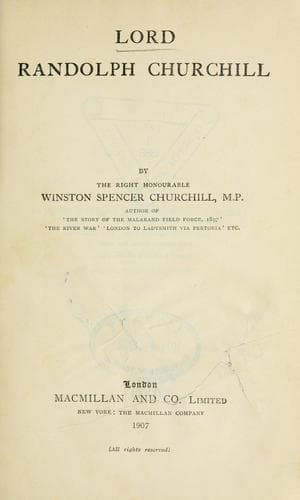
Churchill, Randolph Henry Spencer, Lord, 1849-1895
Lord Randolph had returned from India at a time when Indian problems
occupied all minds. The turbulence of English politics was hushed for a
space by a perilous interlude. In the year 1884, after the occupation of
Merv, the Russian Empire attained the limits of its expansion southwards
and came at last into contact with the territories of the Amir, to whom,
by the engagements of 1880, Great Britain had given a pledge of
protection against external aggression. A joint demarcation of the
northern boundary of Afghanistan was decided on by the British and
Russian Governments, from the Persian border eastwards to a point on the
Oxus, beyond which that river had been recognised by the agreement of
1873 as constituting the limits of Afghan territory. The Commissioners
of the two Powers had met on the frontier in November 1884, and devoted
themselves to their task with that air of leisurely diligence
inseparable from international undertakings. On March 30 the tangled
negotiations were torn to pieces by an act of violence. While
diplomatists were groping for scientific frontiers upon imperfect maps
and amid unfamiliar names, General Komaroff advanced, ‘covenant’
notwithstanding, collided with the Afghan pickets upon the debatable
ground, and in a short but bloody action at Penjdeh drove the Amir’s
forces from the field. All England was stirred. The newspapers were hot
to counsel war. A wave of double panic swept across the country. The
national temper rose and the funds fell. A period of acute suspense
followed.
On all that concerned the safety of India Lord Randolph spoke in
picturesque and thoughtful language. ‘Our rule in India,’ he said at the
Primrose League banquet in the St. James’s Hall on April 18, ‘is, as it
were, a sheet of oil spread out over the surface of, and keeping calm
and quiet and unruffled by storms, an immense and profound ocean of
humanity. Underneath that rule lie hidden all the memories of fallen
dynasties, all the traditions of vanquished races, all the pride of
insulted creeds....’ He spoke of the advance of Russia on the North-West
Frontier--‘that sometimes stealthy, sometimes open, always gradual,
always sure advance of countless hosts, now resembling the gliding of a
serpent, now the bound of a tiger’--as a perpetual injury to stability
and progress in the Government and people of India. And his counsels,
like those of Lord Salisbury, seemed full of the menace of war.
Public-domain text, read in full here on John Shaqi.
Reviews
Reviews
No reviews yet
Be the first to share your thoughts on this work.
Elsewhere in the archive
Join the Discussion
Join the discussion
Sign in to leave a comment or review.
Sign InorCreate an account