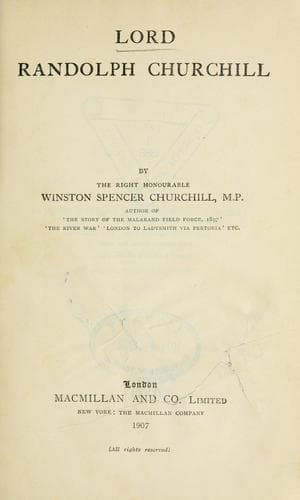
Churchill, Randolph Henry Spencer, Lord, 1849-1895
‘The second part of the difficulty,’ proceeds the memorandum, ‘which
confronted Lord Salisbury was political and arose entirely out of the
question whether it was or was not essential and necessary to seek from
Parliament a renewal of the expiring Irish Crimes Act. This question had
been more than once discussed in small conciliabules before the fall of
Mr. Gladstone’s Government, and a sort of decision arrived at. I alluded
publicly to the subject in a speech I made at Sheffield in the following
September. But the former semi-decision did not help Lord Salisbury much
when the actual crisis came. The whole question was again gone over with
great care. Mr. Gibson in this difficulty was the real arbiter. He was
the principal, and indeed the only, adviser to whom Lord Salisbury and
his friends could have recourse for Irish information. In all the
recurring debates on the state of Ireland and on the Irish land
legislation which had marked the preceding sessions since 1880 he had
been the real leader, and with him naturally it rested now to decide
practically this grave and difficult question. I use the adjective
“grave” because I believe that the decision not to attempt to renew the
Crimes Act, more than any other event, finally determined Mr. Gladstone
no longer to resist Repeal, and by some process or calculation not open
to ordinary persons led Mr. Gladstone to the conclusion that there was a
real working alliance arrived at between the Tories and the party of Mr.
Parnell, the legitimate results of which would be proposals by the Tory
Government in the nature of very large concessions to the Irish in the
direction of Repeal.
‘My own part in the matter was to express no opinion beyond what was
contained in the following formula, from which I never departed, and
which was accepted by Lord Salisbury and his friends: If it is decided
that the state of Ireland is such as to require the further continuance
of the Crimes Act, then the Conservative party cannot accept office, as
the period of the session and the Parliamentary weakness of the party
preclude the possibility of their passing through the House of Commons
the necessary measure. If a contrary decision is arrived at--viz. that
the Act may be allowed to expire--then the Conservative party might
succeed the Liberal Government with safety and advantage. It was well
known that personally I would not have taken office had it been thought
necessary by a Conservative Government to attempt to renew the Crimes
Act.
Public-domain text, read in full here on John Shaqi.
Reviews
Reviews
No reviews yet
Be the first to share your thoughts on this work.
Elsewhere in the archive
Join the Discussion
Join the discussion
Sign in to leave a comment or review.
Sign InorCreate an account