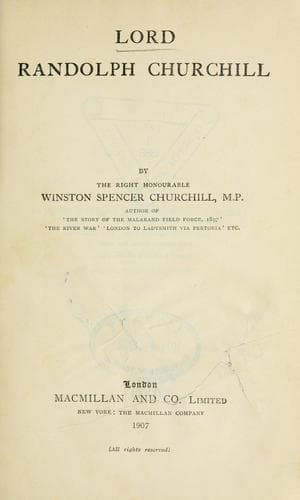
Churchill, Randolph Henry Spencer, Lord, 1849-1895
Sir Michael Hicks-Beach then got up from the Front Opposition Bench and,
to the astonishment of his colleagues on the Treasury Bench, spoke in
favour of the adjournment and against his leader. In the division the
Conservative party split into puzzled fragments, and persons who thought
they might be Under-Secretaries--and in such circumstances they are a
respectable body--suffered acutely. Thirty-five members voted with Sir
Michael and Lord Randolph for the adjournment. Sir Henry Wolff and Mr.
Gorst were their tellers. The rest, with Sir Stafford Northcote at their
head, went into the Government lobby to support Mr. Gladstone. Sir Henry
Wolff’s colleague in the representation of Portsmouth was a venerable
member of the orthodox Conservative party. As he passed the Front
Opposition Bench on his way to vote with Lord Randolph Churchill, Sir
Stafford Northcote said reproachfully: ‘These are the times when one can
tell one’s friends.’ ‘At such a crisis,’ replied the old gentleman
ruefully, ‘and with such an election before us, the representation of
Portsmouth must be undivided.’
This was the end. Two days later it was formally announced that Sir
Stafford Northcote would retire to the House of Lords and that Sir
Michael Hicks-Beach would lead the House of Commons. It has been
asserted that this division settled the struggle and that Lord
Salisbury, confronted with this plain proof that Sir Stafford
Northcote’s leadership would not be accepted by a powerful and active
section of his party, capitulated to Lord Randolph Churchill. This is
not quite true. No doubt the division clinched the issues; but the
personal negotiations which resulted in Sir Stafford’s elevation were
already far advanced; and he himself notes in his diary of June 15:
‘This has apparently been my last night in the House of Commons.’
Indeed, there seems to have been less design in the affair than is
commonly supposed. Few people--even among the most intelligent and
informed--will believe how much in modern English politics is settled by
the accident or caprice of the hour. Lord Randolph Churchill had often
voted and spoken against the leader of the Opposition before. He thought
the acquiescence in Mr. Gladstone’s wishes on this occasion stupid, and
he said so. He thought the House should adjourn without transacting
business and he voted in that sense. Sir Michael Hicks-Beach was party
to no plot. He did not enter the House until late and had not heard Sir
Stafford’s speech. He gathered from the debate that the Fourth Party and
the ‘Janissaries’ were attacking the Government and he supported them on
general principles. Not until he sat down did he learn what he had done.
Moreover, before the division had taken place Lord Salisbury’s hopes of
a settlement were already so good that he had sent the following letter
to Lord Randolph Churchill:--
_Private._
20 Arlington Street, S.W.: June 15, 1885.
Public-domain text, read in full here on John Shaqi.
Reviews
Reviews
No reviews yet
Be the first to share your thoughts on this work.
Elsewhere in the archive
Join the Discussion
Join the discussion
Sign in to leave a comment or review.
Sign InorCreate an account