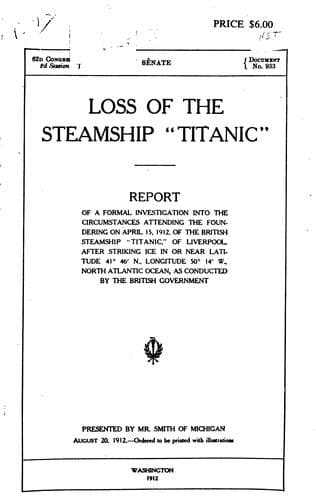
Loss of the Steamship "Titanic"Great Britain. Court to investigate loss of steamship "Titanic"
History
Loss of the Steamship "Titanic"
Great Britain. Court to investigate loss of steamship "Titanic"
Shipwrecks; Titanic (Steamship)
17. That the board of trade should be satisfied in each case before the
ship leaves port that a scheme has been devised and communicated to each
officer of the ship for securing an efficient working of the boats.
GENERAL.
18. That every man taking a lookout in such ships should undergo a sight
test at reasonable intervals.
19. That in all such ships a police system should be organized so as to
secure obedience to orders, and proper control and guidance of all on
board in times of emergency.
20. That in all such ships there should be an installation of wireless
telegraphy, and that such installation should be worked with a
sufficient number of trained operators to secure a continuous service by
night and day. In this connection regard should be had to the
resolutions of the International Conference on Wireless Telegraphy
recently held under the presidency of Sir H. Babington Smith. That where
practicable a silent chamber for "receiving" messages should form part
of the installation.
21. That instruction should be given in all steamship companies'
regulations that when ice is reported in or near the track the ship
should proceed in the dark hours at a moderate speed or alter her course
so as to go well clear of the danger zone.
22. That the attention of masters of vessels should be drawn by the
board of trade to the effect that under the maritime conventions act,
1911, it is a misdemeanor not to go to the relief of a vessel in
distress when possible to do so.
23. That the same protection as to the safety of life in the event of
casualty which is afforded to emigrant ships by means of supervision and
inspection should be extended to all foreign-going passenger ships.
24. That (unless already done) steps should be taken to call an
international conference to consider and as far as possible to agree
upon a common line of conduct in respect of (_a_) the subdivision of
ships; (_b_) the provision and working of life-saving appliances; (_c_)
the installation of wireless telegraphy and the method of working the
same; (_d_) the reduction of speed or the alteration of course in the
vicinity of ice; and (_e_) the use of searchlights.
MERSEY,
_Wreck Commissioner_.
We concur.
ARTHUR GOUGH-CALTHORPE,
A. W. CLARKE,
F. C. A. LYON,
J. H. BILES,
EDWARD C. CHASTON,
_Assessors_.
JULY 30, 1912.
FOOTNOTES:
[1] There was another water-tight door at the after end of the
water-tight passage through the bunker immediately aft of D bulkhead.
This door and the one on the D bulkhead formed a double protection to
the forward boiler room.
[2] The water-tight doors for these bulkheads were not on them, but were
at the end of a water-tight passage (about 9 feet long), leading from
the bulkhead through the bunker into the compartment.
[3] Floated off when the ship sank and was utilized as a raft.
Public-domain text, read in full here on John Shaqi.
Reviews
Reviews
No reviews yet
Be the first to share your thoughts on this work.
Elsewhere in the archive
Join the Discussion
Join the discussion
Sign in to leave a comment or review.
Sign InorCreate an account