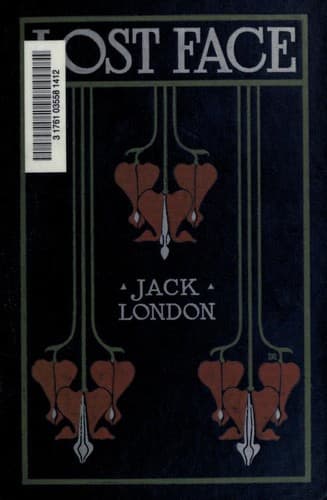
Adventure stories, American; American fiction -- 20th century; Short stories; Western stories
Curly Jim filled the glasses triumphantly. O’Brien downed his drink and
bent forward with wobbling pen to affix his signature. Before he had
made more than a blot, he suddenly started up, impelled by the impact of
an idea colliding with his consciousness. He stood upon his feet and
swayed back and forth before them, reflecting in his startled eyes the
thought process that was taking place behind. Then he reached his
conclusion. A benevolent radiance suffused his countenance. He turned
to the faro dealer, took his hand, and spoke solemnly.
“Curly, you’re my frien’. There’s my han’. Shake. Ol’ man, I won’t do
it. Won’t sell. Won’t rob a frien’. No son-of-a-gun will ever have
chance to say Marcus O’Brien robbed frien’ cause frien’ was drunk.
You’re drunk, Curly, an’ I won’t rob you. Jes’ had thought—never thought
it before—don’t know what the matter ’ith me, but never thought it
before. Suppose, jes’ suppose, Curly, my ol’ frien’, jes’ suppose there
ain’t ten thousan’ in whole damn claim. You’d be robbed. No, sir; won’t
do it. Marcus O’Brien makes money out of the groun’, not out of his
frien’s.”
Percy Leclaire and Mucluc Charley drowned the faro dealer’s objections in
applause for so noble a sentiment. They fell upon O’Brien from either
side, their arms lovingly about his neck, their mouths so full of words
they could not hear Curly’s offer to insert a clause in the document to
the effect that if there weren’t ten thousand in the claim he would be
given back the difference between yield and purchase price. The longer
they talked the more maudlin and the more noble the discussion became.
All sordid motives were banished. They were a trio of philanthropists
striving to save Curly Jim from himself and his own philanthropy. They
insisted that he was a philanthropist. They refused to accept for a
moment that there could be found one ignoble thought in all the world.
They crawled and climbed and scrambled over high ethical plateaux and
ranges, or drowned themselves in metaphysical seas of sentimentality.
Curly Jim sweated and fumed and poured out the whisky. He found himself
with a score of arguments on his hands, not one of which had anything to
do with the gold-mine he wanted to buy. The longer they talked the
farther away they got from that gold-mine, and at two in the morning
Curly Jim acknowledged himself beaten. One by one he led his helpless
guests across the kitchen floor and thrust them outside. O’Brien came
last, and the three, with arms locked for mutual aid, titubated gravely
on the stoop.
“Good business man, Curly,” O’Brien was saying. “Must say like your
style—fine an’ generous, free-handed hospital . . . hospital . . .
hospitality. Credit to you. Nothin’ base ’n graspin’ in your make-up.
As I was sayin’—”
But just then the faro dealer slammed the door.
The three laughed happily on the stoop. They laughed for a long time.
Then Mucluc Charley essayed speech.
Public-domain text, read in full here on John Shaqi.
Reviews
Reviews
No reviews yet
Be the first to share your thoughts on this work.
Join the Discussion
Join the discussion
Sign in to leave a comment or review.
Sign InorCreate an account