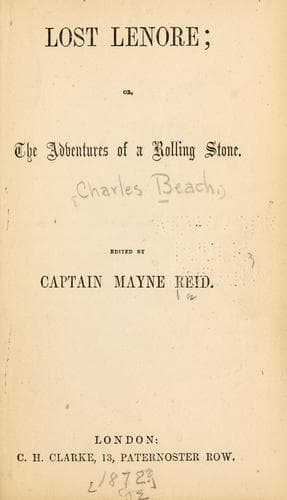
Lost Lenore: The Adventures of a Rolling StoneReid, Mayne
General
Lost Lenore: The Adventures of a Rolling Stone
Reid, Mayne
Adventure stories; Dime novels; Fiction
"My anger has now entirely passed away; and yet I know I am still having
some revenge--in addition to that I have already got. Wherever they may
be, they are not living happily. They know that they have done wrong;
and I'd lay a wager, there's not an hour of the day that they're not
thinking of me, and dreading that I will make my appearance.
"I can return to my native land, and be happy. They cannot. I never
wish to see either of them again: for I have become philosophical, and
am willing that their crime should bring about its own punishment."
I congratulated Farrell on the philosophy that had enabled him so
successfully to regain his tranquillity of spirit; and, after giving
each other mutual directions for meeting again, we parted company.
Volume Two, Chapter XXX.
ODD FASHIONS IN THE GOLD FIELDS.
Farrell's philosophical resolve--to trouble the delinquents no more--
formed the subject of my reflections, as I walked towards my tent. It
was an illustration of the power which circumstances may have, in
allaying even the strongest passion: for I knew that, when first made
acquainted with his dishonour, the man had felt both deeply and
resentfully.
I could not help applying the lesson to myself. "Is it possible,"
thought I, "that any circumstances can ever arise to allay my longings
for Lenore? Is there in time a power that will yet appease them?"
My sentimental reflections were interrupted, by a scene that was of a
different character--altogether comical. Not far from the place where I
had parted with Farrell, I saw a crowd collected around a tent. Two
miners, who had been "regular mates," were quarrelling; and their
neighbours had gathered upon the ground, to be edified by an abundance
of vituperative eloquence.
After the two men had, for a considerable time, amused the bystanders
with their dispute, there appeared to be but one point upon which they
could agree. That was that they should remain "mates" no longer.
The tent, some provisions in it, along with their mining tools and
cooking utensils, they owned in common: having shared between them the
expense attending their purchase.
As these things could not be divided to the satisfaction of both
parties, it was proposed that each should remove from the tent, whatever
was fairly entitled to be called his "private property," and that
everything held in common--including the tent itself--should be burnt!
This proposal was at once agreed to.
Public-domain text, read in full here on John Shaqi.
Reviews
Reviews
No reviews yet
Be the first to share your thoughts on this work.
Elsewhere in the archive
Join the Discussion
Join the discussion
Sign in to leave a comment or review.
Sign InorCreate an account