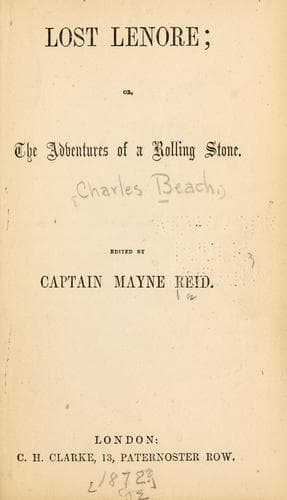
Lost Lenore: The Adventures of a Rolling StoneReid, Mayne
General
Lost Lenore: The Adventures of a Rolling Stone
Reid, Mayne
Adventure stories; Dime novels; Fiction
"At that moment, one of the constables shouted `a rescue;' and the
three, without further provocation, commenced an assault upon my brother
and myself.
"One of them seized me by the throat; and struck me several times on the
head with his baton. We struggled awhile, and then both fell to the
ground. I turned my head, while trying to get up again, and saw my
brother lying on the pavement, with his face covered all over with
blood. The policeman, who had fallen with me, still retained his clutch
upon my throat; and again commenced beating me as soon as we had both
recovered our feet. A loose stone, weighing about ten pounds, was lying
upon the pavement. I seized hold of it, and struck my antagonist on the
forehead. He fell like a bullock. When I looked around, I saw that my
father--who was a very powerful man--had conquered the other two
policemen. He seemed suddenly to have recovered from his intoxication;
and now helped me to carry the constable I had felled, to the nearest
public-house--where the man died a few hours after the affray.
"I was tried for manslaughter; and sentenced to ten years
transportation.
"Not until then, did evil thoughts ever make their home in my mind.
"Up till the time I was torn from my relatives--for whom I had a great
affection--and from the girl whom I fondly loved, I am willing to be
responsible to God and man, for every thought I had, or every act I did.
Ever since, having been deprived of liberty--dragged from all near and
dear--with every social tie broken--and robbed of everything for which I
cared to live--I do not think myself to blame for anything I may have
done. I have been only a link in a chain of circumstances--a victim of
the transportation system of England, that transforms incipient crime
into hardened villainy.
"On arriving in New South Wales, I was placed in a gang with other
convicts; and put to the business of pushing a wheel-barrow. We were
employed in removing a hill, from the place where nature had set it: for
no other reason, I believe, than for the purpose of keeping us from
being idle! The labour was not severe; but the life was a very weary
one. It was not the work that made it so to me. I was used to work,
and did not dislike it, if there had been any sense in the task we had
to perform. But I had no more idea of what my labour was for, than the
wheel-barrow with which I performed it; and therefore I could feel no
more interest in the work, than did the barrow itself.
"My toil was not sweetened with the reflection that it was in behalf of
those I loved. On the contrary, I knew that the best years of my life
were being uselessly squandered, while my mother and her children were
perhaps suffering for food!
Public-domain text, read in full here on John Shaqi.
Reviews
Reviews
No reviews yet
Be the first to share your thoughts on this work.
Elsewhere in the archive
Join the Discussion
Join the discussion
Sign in to leave a comment or review.
Sign InorCreate an account