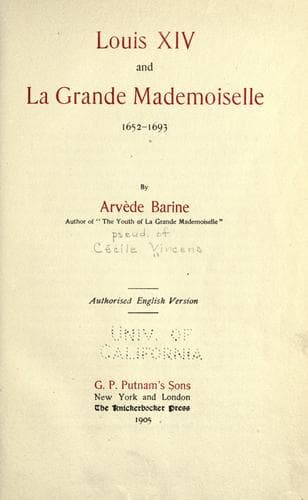
Louis XIV and La Grande Mademoiselle, 1652-1693Barine, Arvède
History
Louis XIV and La Grande Mademoiselle, 1652-1693
Barine, Arvède
Louis XIV, King of France, 1638-1715; Montpensier, Anne-Marie-Louise d'Orléans, duchesse de, 1627-1693
Surrounded by free-thinkers without prejudices, himself more or less of
a free-thinker, he resembles so little, either morally or physically,
the bewigged figure of the end of the reign, and of the _Memoires_ of
Saint-Simon, that he appears as another individual. How easily both
proprieties and punishments are put on one side when passion reigns,
but how much more alive, how much more of a natural human being,
compared to the wooden figure of the portraits of Versailles, is the
King as now seen; Louis XIV. is decidedly an enigmatical quantity.
It would be inexact to state that passions had become more lively than
they were during the wars of the Fronde, an epoch especially ardent; but
they had certainly changed their character, as had the tastes, ideas,
literature, and fashions in general. This is the usual course of events,
and, as we have seen, the movement was precipitated under the influence
of a monarch all-powerful, determined to efface the past.
An artistic event which should not be overlooked had favoured the
designs of Louis XIV., in opening unknown perspectives to the curious
after new sensations, already numerous in the seventeenth century.
Dramatic music made its entry into the modern world. It brought with it,
according to the phrase of one of its historians, M. Romain
Rolland,[187] an "unlimited power for expressing passion, and with
passionate emotion all that remains incommunicable through the medium of
language alone." We may or may not love music, but it must be admitted
that a creation of this nature will certainly exercise a strong
influence over the refined portion of a nation.
French society could not escape. The new art was in train to modify the
nervous system, if I dare thus speak, of the world in which flourished,
under the royal protection, those rather perilous ideas upon the rights
of nature and the fatality of passion. Day by day, new chords were
struck upon impressionable hearts. Dramatic music was born in Italy; as
might well be. In the year 1597, upon a carnival evening, a rich
Florentine entertained a choice audience with a musical tragedy called
_Dafne_, of which the score is lost. According to one of the guests,
"the pleasure and astonishment which seized the soul of the auditors
before so novel a spectacle could hardly be expressed."
M. Romain Rolland confirms this testimony: "It was like a thunderbolt.
All felt themselves in the presence of a new art." In ten years Italian
opera reached its full growth, thanks chiefly to a composer of genius,
Monteverde, whose _Ariane_ caused an audience of more than six thousand
persons to burst into sobs on its first representation.
The art of singing had marched side by side with dramatic music and
attained its height almost at once. A famous soprano, Vittori, threw the
public into almost inconceivable transports. "Many persons were suddenly
forced to loosen their garments in order to breathe, so suffocated were
they with emotion."
Public-domain text, read in full here on John Shaqi.
Reviews
Reviews
No reviews yet
Be the first to share your thoughts on this work.
Elsewhere in the archive
Join the Discussion
Join the discussion
Sign in to leave a comment or review.
Sign InorCreate an account