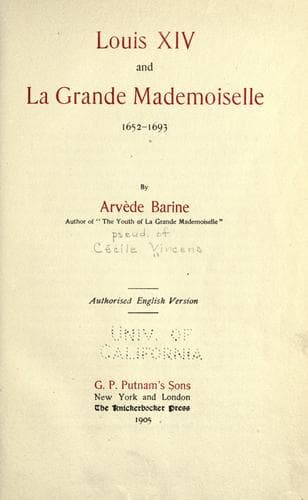
Louis XIV and La Grande Mademoiselle, 1652-1693Barine, Arvède
History
Louis XIV and La Grande Mademoiselle, 1652-1693
Barine, Arvède
Louis XIV, King of France, 1638-1715; Montpensier, Anne-Marie-Louise d'Orléans, duchesse de, 1627-1693
While the decorations and the dances charmed the eyes, as the "machines"
amused by their complications, the words and music, outdoing the
_Princesse d'Elide_,[189] murmured unceasingly with the same caressing
languor that no youthful beings have the right, for any motive whatever,
to deny to themselves the duty of loving. "Yield, give yourselves up to
transports," chants a chorus of _Amadis_. The thirteen "lyrical
tragedies" given by Quinault and Lulli from 1673 to 1686 are all
constructed upon this one theme. They gave expression to the one
single idea; "Yield! surrender yourselves!" and resulted in producing a
certain eloquence from their monotony. When these lyrics are played on
the piano,[190] a better means of hearing them failing, one cannot but
feel that in spite of their insipidity the continuous appeal to the
senses might produce in the end, particularly in the atmosphere of a
theatre, a strong effect.
[Illustration: =JEAN BAPTISTE DE LULLI= After a contemporary print by
Bonnart]
Moralists recognised this. All will remember the violent attack of
Boileau upon the opera. To-day we consider this attack as having been
too narrowly virtuous, even a little ridiculous. It can be explained,
however, in considering what a novelty it was to see people seized with
nervous attacks and fits of weeping while listening to singing. Was it
the "loose morals" of Quinault which caused these? Was it the new music?
In either case, the worthy Boileau was excusable for his alarm.
France had not yet reached the point of excitability which existed in
Italy. The French are not a sufficiently musical race for this; but in a
less degree, the country submitted to the extraordinary power of the
dramatic style. It is known through Mme. de Sevigne that if the French
listeners did not invariably "burst into sobs" or "suffocate with
emotion," more than one auditor, including herself, wept silently in
hearing the fine passages.
Fashion also swayed affairs, and we know of what fashion is capable in
France.
Saint Evremond has written a comedy entitled _The Operas_. In the list
of _dramatis personae_, one reads: "Mlle. Crisotine become mad through
the hearing of operas. Tirsolet, a young man from Lyons, also became mad
through operas." A third person relates that "nothing else is spoken of
in Paris. Women and even young children knew the operas by heart, and
there is hardly a house in which entire scenes are not sung." How nearly
France and Italy are approached in this. The Louvre party caught the
fashion, the courtiers, being eager to imitate the King, a great admirer
of Lulli.
Public-domain text, read in full here on John Shaqi.
Reviews
Reviews
No reviews yet
Be the first to share your thoughts on this work.
Elsewhere in the archive
Join the Discussion
Join the discussion
Sign in to leave a comment or review.
Sign InorCreate an account