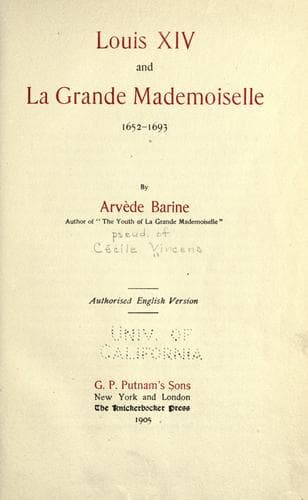
Louis XIV and La Grande Mademoiselle, 1652-1693Barine, Arvède
History
Louis XIV and La Grande Mademoiselle, 1652-1693
Barine, Arvède
Louis XIV, King of France, 1638-1715; Montpensier, Anne-Marie-Louise d'Orléans, duchesse de, 1627-1693
Dramatic music has now established itself. The civilised world discovers
with delight that this art has an unlimited capacity for expressing
passion, and all the passions, even the highest, the purest, and this
latter includes love. It has also been recognised that music can speak
in its own words outside of the theatre, in a symphony, in a simple
sonata, and that there exists no art so benevolent, so reposeful, and so
reassuring to troubled souls. In spite of this, in spite of all,
moralists have never been willing to throw down their weapons before
music. Emanuel Kant was clearly hostile to it; he said, "It enervates
man,"[193] and he turned away his disciples from its joys. Tolstoi has
been unkind to it in the _Kreutzer Sonata_.
All forces can become dangerous; it depends on the "use made of
them,"[194] and also upon the souls which receive the impulse; they must
be of the calibre to support its force.
The action of music upon French society has never, so far as I know,
been methodically studied in relation to its effects, both physical and
moral. If a historian be found, he will issue from the psychological
laboratories, scientifically equipped, in which the observer conceals
the physician: on this condition only can he speak with authority.
[Illustration: =BOILEAU= After the painting by H. Rigaud]
The Grande Mademoiselle cared but little for music. Nevertheless she
extols Lulli in her _Memoires_: "He makes the most beatific airs in the
world." The glory of Baptiste touched her because he was "her own,"
arriving from Italy some time before the Fronde. "He came to France with
my late uncle the Chevalier de Guise. I had prayed him to bring me an
Italian, with whom I could speak and learn the language."
Lulli was only a boy of thirteen at the time that he was brought to
France. Between the Italian lessons, he filled the office of cook.
Later, admitted among the violins of Mademoiselle, it is related that he
was chased away for having satirised his mistress in song. This recalls
other events:
I was exiled: he did not wish to live in the country: he
demanded leave to go away: I accorded it, and since he has made
his fortune, for he is a great merry-andrew.
Lulli always remained a buffoon in the mind of Mademoiselle, although
she assisted at his triumphs and survived him.
Public-domain text, read in full here on John Shaqi.
Reviews
Reviews
No reviews yet
Be the first to share your thoughts on this work.
Elsewhere in the archive
Join the Discussion
Join the discussion
Sign in to leave a comment or review.
Sign InorCreate an account