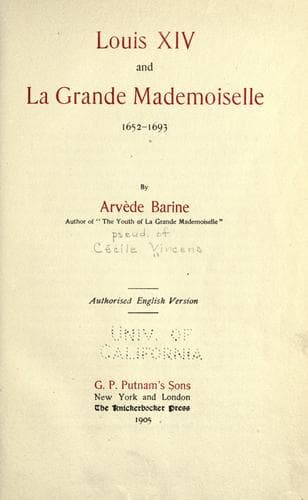
Louis XIV and La Grande Mademoiselle, 1652-1693Barine, Arvède
History
Louis XIV and La Grande Mademoiselle, 1652-1693
Barine, Arvède
Louis XIV, King of France, 1638-1715; Montpensier, Anne-Marie-Louise d'Orléans, duchesse de, 1627-1693
Racine appeared on the scene as a revolutionary force. He and Moliere,
sustained by their friend Boileau, presented a dramatic art absolutely
new, which was separated by a gulf from that of Corneille and for which
nothing had prepared the way. Corneille's predecessors were Mairet, the
du Ryers and many others: Racine stood alone. He was the first and the
last to make tragedy realistic, with the subject simple, the characters
scrupulously true to nature, and the language often audaciously
familiar.
Louis XIV. applauded. Racine and the King well comprehended each other.
Heinrich Heine has given the reason for this in one of those phrases
which throw light upon an entire period: "Racine is the first modern
poet, as Louis XIV. was the first modern King."
The young Court applauded cordially with the King. It also belonged to
the new regime; but for the old Court, for the survivors of the Hotel
Rambouillet, the tragedy of Racine was as shocking, as displeasing, as
were the first realistic romances to the faithful adherents of
romanticism, and for the same reasons. In spite of the difficulty so
many have, of sympathising with the ideas of the one called a little
disdainfully "the gentle Racine," "the elegant Racine," this writer
appeared neither gentle nor elegant to three-fourths of the salon, to
the "old Court" of the Grande Mademoiselle. The _Pyrrhus_ seemed to them
"brutal," the Phedre, a "madwoman" "the blackness" of Nero or Narcisse
entirely beyond what should be permitted on the stage.
Not that the personages of Corneille or of his predecessors acted less
wickedly, but their brutes and villains were nevertheless "heroes" and
that made all the difference. The personages created by Racine were only
"men," simple men, who used words "low and grovelling," bourgeois
words, expressions such as "Quoi qu'il en soit, que fais je, que
dis-je!"[198] and did not even realise the sense: more than three
hundred improper terms have been counted in _Andromaque_. Racine would
have fared better if his poetic methods had not been in some way a
criticism upon the cleverness of Corneille. This was the real grievance,
obliging the adorers of the old poet to condemn the insolent one.
Public-domain text, read in full here on John Shaqi.
Reviews
Reviews
No reviews yet
Be the first to share your thoughts on this work.
Elsewhere in the archive
Join the Discussion
Join the discussion
Sign in to leave a comment or review.
Sign InorCreate an account