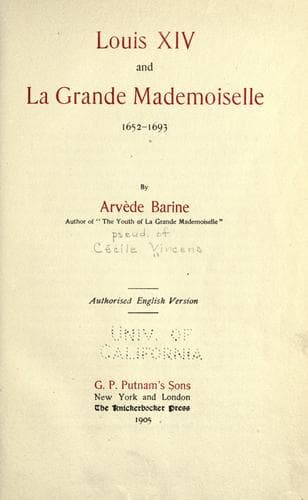
Louis XIV and La Grande Mademoiselle, 1652-1693Barine, Arvède
History
Louis XIV and La Grande Mademoiselle, 1652-1693
Barine, Arvède
Louis XIV, King of France, 1638-1715; Montpensier, Anne-Marie-Louise d'Orléans, duchesse de, 1627-1693
In the spring of 1669, Louis XIV. one day was listening to the Comtesse
de Soissons sing. She was the second of the Mazarin nieces, and the only
really wicked one in the family. She sang a new song containing many
naughty couplets, in which mud was thrown upon some of the courtiers.
Men and women received their packet under the guise of mock praise,
according to a fashion much in vogue. The phrase "mock praise" had
become the name of a form of satire, which made an almost unique
literature. The King permitted the couplets to pass in silence. He did
not even protest at this one:
Et pour M. Le Grand,[209]
Il est tout mystere;
Quand il est galant,
Il a comme La Valliere
L'esprit penetrant.
The Countess then arrived at a couplet on Puyguilhem, better known under
the name of Lauzun.[210]
De la cour
La vertu la plus pure
Est en Peguilin....
At this place the King interrupted: "If it is wished to vex him, they
are wrong, but when people act as he has done, they must be let alone;
as for others, they are badly treated." The sudden displeasure of the
King at the mention of Puyguilhem caused a general silence, and the song
stopped at this point.
The Grande Mademoiselle was present at this scene, and was surprised to
discover that she was not indifferent to its import. Up to this time,
she had scarcely known Lauzun, who did not belong to her coterie. "It
pleased me," says her _Memoires_, "to hear the manner in which the King
spoke of him; I felt some instinct of the future." This was the first
warning of the passion which had already insinuated itself into the
depths of her heart; but she did not yet comprehend it. The idea came to
her, however, of seizing an occasion to converse with Lauzun. She felt
an inclination for this at once. "He has," said she, "a manner of
explaining himself which is very extraordinary." Mademoiselle was
interested, but she still believed that it was only the conversational
capacity which pleased her in the little cadet of Gascony. She began to
query, however, why, having been sufficiently content during her five
years of exile, she was now so willing to remain a fixture. The year had
ended before she found a satisfactory response to this question: "I went
in the month of December (the 6th) to Saint-Germain, from which I did
not depart. I soon accustomed myself to it. Ordinarily, I only stayed
three or four days, and my present long sojourn surprised every one."
Public-domain text, read in full here on John Shaqi.
Reviews
Reviews
No reviews yet
Be the first to share your thoughts on this work.
Elsewhere in the archive
Join the Discussion
Join the discussion
Sign in to leave a comment or review.
Sign InorCreate an account