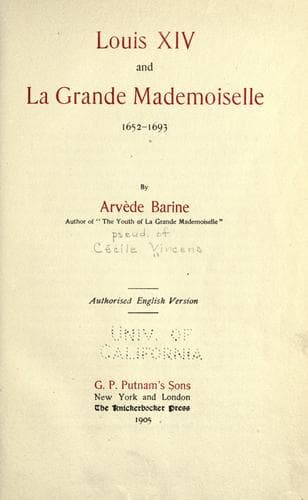
Louis XIV and La Grande Mademoiselle, 1652-1693Barine, Arvède
History
Louis XIV and La Grande Mademoiselle, 1652-1693
Barine, Arvède
Louis XIV, King of France, 1638-1715; Montpensier, Anne-Marie-Louise d'Orléans, duchesse de, 1627-1693
One single thought, characteristic of her generation, came to trouble
her happiness; she queried of herself if the great princesses of the
theatre of Corneille would have married a cadet of Gascogne. Assuredly,
passion blows where it listeth. Corneille had never denied this; but he
had maintained that the will should render us masters of our affections,
and his plays bear witness that love, even when founded in a just
feeling of admiration, can efface itself before the sentiment of the
duty owed to rank. Happily, poets, even when they are named Corneille,
sometimes contradict themselves, and Mademoiselle, who had seen plays
since the days of swaddling clothes, well knew her _repertoire_. She now
recalled for her comfort a passage in the _Suite du Menteur_ which
clearly established the "predestination of marriage, and the foresight
of God," so that it was a Christian duty to submit without resistance to
sentiments sent to us "from the sky."
Although sure of her own memory, which was indeed excellent,
Mademoiselle sent in great haste to Paris to secure a copy of the play,
and found the page (Act IV.) in which Melisse confides to Lise his love
for Dorante:
Quand les ordres du ciel nous ont faits l'un pour l'autre,
Lise, c'est un accord bientot fait que le notre.
Sa main entre les c[oe]urs, par un secret pouvoir,
Seme l'intelligence avant que de se voir;
Il prepare si bien l'amant et la maitresse,
Que leur ame au seul nom s'emeut et s'interesse.
On s'estime, on se cherche, on s'aime en un moment;
Tout ce qu'on s'entredit persuade aisement;
Et, sans s'inquieter de mille peurs frivoles,
La foi semble courir au-devant des paroles.
How was it possible to doubt for a single instant after having read
these verses that there is impiety in disobeying the "commands" to love
which come to us from on high? Nevertheless, serious conflicts took
place in the soul of the royal pupil of Corneille. Sometimes she
represented to herself with vivacity the joys of marriage, among the
keenest of which would be the witnessing the vexation of her heirs, who
were already beginning to find that she was making them wait too long,
and whom she longed to disappoint. Sometimes her mind could only dwell
upon the scandal which such a _mesalliance_ would cause, the reprobation
of some, and the laughter of others, and then her pride rose in arms.
She thus on one day desired the marriage eagerly, while on the next she
detested the thought of it, the vacillation depending upon the fact of
her having between times seen or not seen M. de Lauzun.
This struggle between the head and the heart was prolonged during
several weeks;
Public-domain text, read in full here on John Shaqi.
Reviews
Reviews
No reviews yet
Be the first to share your thoughts on this work.
Elsewhere in the archive
Join the Discussion
Join the discussion
Sign in to leave a comment or review.
Sign InorCreate an account