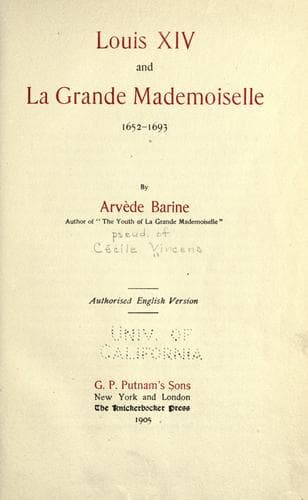
Louis XIV and La Grande Mademoiselle, 1652-1693Barine, Arvède
History
Louis XIV and La Grande Mademoiselle, 1652-1693
Barine, Arvède
Louis XIV, King of France, 1638-1715; Montpensier, Anne-Marie-Louise d'Orléans, duchesse de, 1627-1693
The Marshal kept him and provided for his education. In winter the
little man went to the "academy" to learn to dance, to shoot, and to
ride. In the summer he campaigned with a cavalry regiment belonging to
his uncle. There was apparently no plan for serious study of any kind,
nor even any attention paid to making the youth read. Complete ignorance
was still accepted among the nobility without remark; there had been
little change for the better in this respect since the previous century.
The parents of Lauzun had well judged. In a short time the boy had
wormed himself into the most imposing mansions, the most sacred
chambers. He was seen with the King, he was met in the company of
beautiful ladies. The Court and the city became familiar with his
furtive and impudent physiognomy, which soon grew haughty and insolent.
At eighteen, his father gave him his first military charge. At
twenty-four, he possessed a regiment; then suddenly, when the King came
to power, he received advancements, favours, an always increasing and
inexplicable credit, which aroused for him the hatred of Louvois, for in
the frequent discussions in relation to the service, "the favourite
always conquered." One of his tricks, which was unparalleled for
impudence, and the discovery of which might well have crushed him for
ever, ended in proving his strength.
[Illustration:
Cliche Braun, Clement & Cie.
=DUC DE LAUZUN=
By permission of Messrs. Hachette & Co.]
At about the time when he attracted the attention of the Grande
Mademoiselle, the insatiable little man extracted from his master (under
the condition of secrecy for fear of Louvois) the promise of being
shortly made Grand Master of Artillery. Lauzun was foolish enough not to
be silent. Louvois, once warned, made such strong and convincing
opposition that the King was aroused, and the favourite heard no more of
the appointment. In his anxiety he appealed to Mme. de Montespan. She
was his great friend and promised her aid; but he was distrustful and
wished to "have his mind clear"; then occurred a scene which outraged
Saint-Simon himself, as he related it long after. This writer avows in
his _Memoires_ that it would have been incredible "if the truth had not
been attested by all the Court."
Public-domain text, read in full here on John Shaqi.
Reviews
Reviews
No reviews yet
Be the first to share your thoughts on this work.
Elsewhere in the archive
Join the Discussion
Join the discussion
Sign in to leave a comment or review.
Sign InorCreate an account