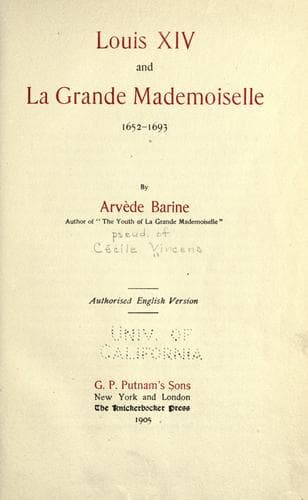
Louis XIV and La Grande Mademoiselle, 1652-1693Barine, Arvède
History
Louis XIV and La Grande Mademoiselle, 1652-1693
Barine, Arvède
Louis XIV, King of France, 1638-1715; Montpensier, Anne-Marie-Louise d'Orléans, duchesse de, 1627-1693
The feelings of Louvois and others can be imagined during the strange
interchange of visits between Saint-Germain and the Bastile, for the
purpose of obtaining from this dangerous personage the acceptance of the
much-desired charge of Captain of the Body Guard; also the alarm at the
prompt[213] return of the favourite, more of a spoiled child than before
the punishment.
Whence came this credit with a prince so little susceptible to
influence, who had always pretended to be as opposed to the rule of
favourites as of prime ministers? In what did this little Lauzun show
special merit? and what attracted women who pursued and sought his
favour through cajoleries and gifts? Little Poucet he still was; for he
had not increased in stature. "He is," wrote Bussy-Rabutin, "one of the
smallest men God has ever made."[214] He had not become more beautiful.
We can on this point believe the testimony of Mademoiselle herself.
However strong her passion, she is yet able to paint Lauzun in these
terms, writing to Mme. de Noailles: "He is a small man. No one can say
that his figure is not the straightest, prettiest, most agreeable. The
limbs are fine; he has good presence in all that he does; but little
hair, blond mixed with grey, ill-combed, and often somewhat greasy; fine
blue eyes, but generally red; a shrewd air; a pretty countenance. His
smile pleases. The end of his nose is pointed and red; something
elevated in his physiognomy; very negligent in attire; when, however, it
appeals to him to be careful, he looks very well. Behold the man!"
This is not an alluring picture. There was but little to attract. It was
murmured that he possessed secret methods of making himself beloved. "As
for his temper and manners," continues Mademoiselle, "I defy any one to
understand them, to explain or to imitate them." The world was not
entirely of this opinion. It could recognise at least that M. de Lauzun
was "the most insolent little man born in the century,"[215] also the
most malicious. Many cruel traits were ascribed to him, and his fashion
of turning on his heel and plunging into the crowd before his victims
had regained their composure was well known.
The world was also well assured that the favourite was an intriguer.
Lauzun was always occupied with some machination, even against those to
whom he was indifferent; this kept his hand in. For the rest,
Mademoiselle was right; he was _not_ understood. He was very
intelligent. His clever phrases were repeated. For example, his response
to the wife of a minister who said rather foolishly, in emphasising the
trouble her husband gave himself: "There is nothing more embarrassing
than the position of the one who holds _la queue de la poele_, is
there?" "Pardon, Madame, there are those who are within."
Public-domain text, read in full here on John Shaqi.
Reviews
Reviews
No reviews yet
Be the first to share your thoughts on this work.
Elsewhere in the archive
Join the Discussion
Join the discussion
Sign in to leave a comment or review.
Sign InorCreate an account