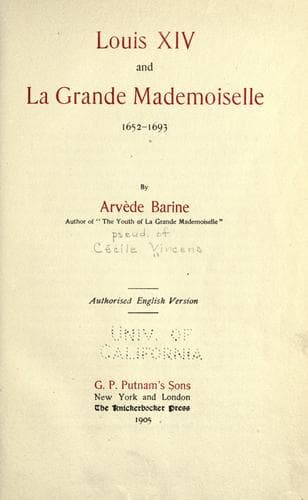
Louis XIV and La Grande Mademoiselle, 1652-1693Barine, Arvède
History
Louis XIV and La Grande Mademoiselle, 1652-1693
Barine, Arvède
Louis XIV, King of France, 1638-1715; Montpensier, Anne-Marie-Louise d'Orléans, duchesse de, 1627-1693
Events moved quietly enough when the Princess one evening in October
supplicated the King that there should be no more said of the project.
Louis XIV. appeared to be indifferent. Monsieur was at first vexed and
then dismissed the subject from his thoughts. Marie-Therese alone,
interested neither in her brother-in-law nor in her cousin, "was in
despair," relates Mademoiselle, "for she wishes that we should marry and
have children." But no one paid much attention to the despair of
Marie-Therese. Lauzun approved the course of Mademoiselle and ceased to
avoid her. That was all. For an ambitious man, he was not a really
clever schemer; he had too great a fear of being duped. He again assumed
a sombre attitude and refused to hear the name of the one chosen by
Mademoiselle. On a certain Thursday evening, when she had menaced him
with the threat of breathing against the mirror and of writing the name
of the man she loved, midnight sounded during this contest. "Nothing
more can be said," observed Mademoiselle, "for it is already Friday."
The next day, taking a sheet of paper, she wrote distinctly, "It is
you," and sealed it. "That day I met him only on the way to supper. I
said: 'I have the name in my pocket, but I do not wish to give it to you
on Friday.' He responded: 'Give it to me! I promise that I will put it
under my pillow and that I will not open the paper until midnight has
passed.'" She did not trust him, and it did not occur to him to
sacrifice a race that had been arranged for the Saturday. "Ah, well, I
will wait until Sunday," said Mademoiselle with inconceivable patience,
and her only vengeance was to let herself be implored a little, before
giving up the paper. The couple were alone in a corner of the fireplace,
in the salon of the Queen. "I drew forth the leaf, upon which only a
single word was written, which, however, told much; I showed it to him,
and then replaced it in my pocket, afterward in my muff. He urged me
very strongly to give it to him, saying that his heart was beating
rapidly.... Before yielding I said, 'You will reply on the same
leaf.'"... In the evening she did not dare to raise her eyes; he
declared that she was mocking him, that "he was not sufficiently foolish
to be deceived," and this was the theme of the letter which he remitted
to her. At the same time, he thought of the prodigious elevation which
he was beginning to realise was a possibility before him. He was at last
aroused, and could not always refrain from responding seriously to
Mademoiselle. She spoke of the happiness which awaited them, and of her
plans to make him the greatest lord in the kingdom. He counselled her
always to bow before fate, but one day he added: "In marrying, the
temperament of those throwing their fates together should be known. I
will disclose mine." He said that he possessed a nature bizarre and
unsociable, being able to live only in the wake of the King; "thus I
Public-domain text, read in full here on John Shaqi.
Reviews
Reviews
No reviews yet
Be the first to share your thoughts on this work.
Elsewhere in the archive
Join the Discussion
Join the discussion
Sign in to leave a comment or review.
Sign InorCreate an account