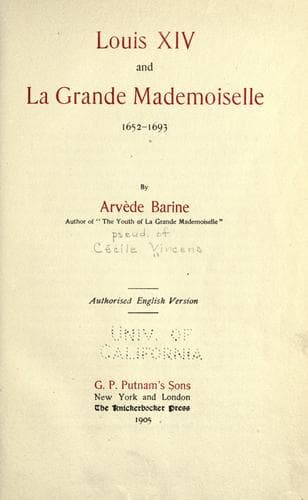
Louis XIV and La Grande Mademoiselle, 1652-1693Barine, Arvède
History
Louis XIV and La Grande Mademoiselle, 1652-1693
Barine, Arvède
Louis XIV, King of France, 1638-1715; Montpensier, Anne-Marie-Louise d'Orléans, duchesse de, 1627-1693
After each effort, she allowed herself slight relaxation and retired to
weep in some corner, then returning to the King with red and swollen
eyes. "I am persuaded" wrote she, apropos of a trip with the Court,
"that my presence has recalled the memory of M. de Lauzun; this is the
reason why I wish to be always before the eyes of the King.... I cannot
believe that he will not feel that my looks are ever supplicating him."
Mademoiselle was very ingenious in her efforts to refer constantly to
the absent one. If a grated window was passed she began to sigh and to
pity those in prison. If there was a rumour that Lauzun was ill, she
solicited by letter the softening of the regime. Louis never responded,
but he did not show any displeasure. The enemies of the disgraced one
endeavoured to detach the Princess from her lover. They knew her
weakness; she was very jealous, and there might easily be occasion in
regard to Lauzun, known as the greatest libertine of this licentious
Court. At the moment of arrest his papers had been seized. There were
many letters; locks of hair and other love tokens, carefully ticketed,
and a sort of secret museum enclosing portraits that Louis XIV. ordered
to be destroyed,--not promptly enough, however, as many persons enjoyed
a glimpse of them, and were able to identify the originals.
The "caskets" of Lauzun were the great social scandal of the winter, and
there were people enough to exploit the contents to Mademoiselle. They
gained nothing for their pains; she had the wisdom not to listen. They
belonged to the past. The same kind friends endeavoured to open her eyes
to the fact that she had been deceived in giving her heart to a man who
only desired her millions. They said: "He did not love you; when he was
promised wealth, appointments, he readily left you; the day on which the
King broke the marriage, Lauzun gambled all the evening with the
greatest tranquility; he cares nothing about you." Mademoiselle allows
in her _Memoires_ that she began to be disturbed when she was forced to
hear such statements from morning till night during a series of years.
Her own remembrances only too well confirmed the truth. She had never
received a word of tenderness from Lauzun, not even a truly gracious
word. But misfortune is an invincible safeguard with generous souls.
Mademoiselle relates that her heart "fought against itself" in favour of
her lover, and the heart conquered, since each new year found her still
devoted, still indefatigable in her efforts to obtain his release.
At the end of eight years there could be no more doubt. Contemporaries
and those of the next generation have tried in vain to discover why
Louis XIV. attached so serious an importance to preventing Lauzun from
receiving news. Of what was he afraid? Was it essential for the safety
of France to insist upon such minute precautions?
Public-domain text, read in full here on John Shaqi.
Reviews
Reviews
No reviews yet
Be the first to share your thoughts on this work.
Elsewhere in the archive
Join the Discussion
Join the discussion
Sign in to leave a comment or review.
Sign InorCreate an account