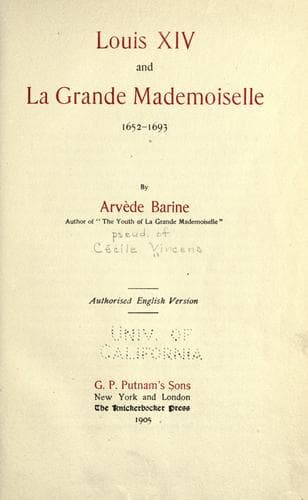
Louis XIV and La Grande Mademoiselle, 1652-1693Barine, Arvède
History
Louis XIV and La Grande Mademoiselle, 1652-1693
Barine, Arvède
Louis XIV, King of France, 1638-1715; Montpensier, Anne-Marie-Louise d'Orléans, duchesse de, 1627-1693
This spectacle provoked such an outburst of tears and groans that it was
impossible to continue the conference. Lauzun "withdrew with Saint-Mars
without speaking." The sister was carried away in a dead faint. The
Chevalier de Lauzun, ill with emotion, retired for the night, and Isarn
shared in the general affliction. At the following sessions, Lauzun
repeated that he comprehended nothing that his advocate said, but he
gave him at the same time some instructions, "with much judgment and
clearness." Touching scenes followed. One day, after having obtained
permission, the prisoner asked if his mother were living, and there was,
in this case, no need of pretence to make the scene impressive. At the
last interview, he charged his sister to implore the pity of the King
and the pardon of Louvois, in humble and submissive terms, which showed
a man conquered, crushed, and henceforth inoffensive.
It may be through compassion, it may be, as was hinted, through some new
and mysterious combination, that this appeal produced a relaxation in
the prison discipline, which ended in a half-freedom. Lauzun was
permitted to give dinners, to buy saddle horses, "to ride in the court
and on the bastions."[274] At length arrived a detachment of musketeers,
charged to conduct him to the baths of Bourbon, under pretext that he
was suffering with one of his arms.
He quitted Pignerol April 22, 1681. Foucquet had died March 23, 1680.
This left to Saint-Mars only a single man of note; the Man with the Iron
Mask had been in the fortress some time at this date.
Robinson Crusoe, leaving his island, was not more of a stranger to the
course of events than a state prisoner after years of life in a dungeon.
Foucquet had believed in listening to Lauzun that he was mentally
deranged. When it was the fate of the latter to again come in contact
with ordinary life, he found much difficulty in placing himself in the
current. The history of France had been lengthened by a chapter while he
was raging in his dungeon. The intimate story of Court life, the most
important for an ancient favourite desirous of regaining a foothold,
would have filled a volume with its tragi-comic complications. At first
glance, the chapter of national history was dazzling. The war with
Holland had given to France, Franche-Comte; to Louis XIV., a glory and
power which had raised him in European opinion above all other
sovereigns.
In the eyes of strangers, he was more than a king, he was _the_ King,
the incarnation of the monarchical idea, the Prince who had made France
the mistress of the civilised world.
Public-domain text, read in full here on John Shaqi.
Reviews
Reviews
No reviews yet
Be the first to share your thoughts on this work.
Elsewhere in the archive
Join the Discussion
Join the discussion
Sign in to leave a comment or review.
Sign InorCreate an account