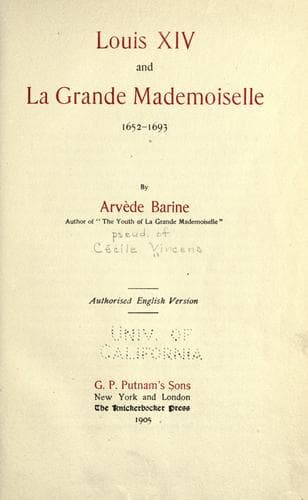
Louis XIV and La Grande Mademoiselle, 1652-1693Barine, Arvède
History
Louis XIV and La Grande Mademoiselle, 1652-1693
Barine, Arvède
Louis XIV, King of France, 1638-1715; Montpensier, Anne-Marie-Louise d'Orléans, duchesse de, 1627-1693
Olivier d'Ormesson, like all the world at first under the influence of
the charm of the young King, wrote in 1665 (March): "No one dares
protest, although all suffer and have their hearts filled with despair;
every one says that it is impossible for this state of things to last,
the conduct of affairs being too unjust and violent."[276] Olivier
d'Ormesson had personal griefs. He had been disgraced for having shown
himself too independent at the time of the prosecution of Foucquet, and
he was also one of those old politicians, liberal after their own
fashion, who held firmly to the privileges belonging to their class, and
who were not accustomed to see criticisms of the King punished more
severely than blasphemies against the Deity. In 1668, a poor old man
from Saint-Germain was accused "of having said that the King was a
tyrant, and that there still existed some Ravaillacs and people of
courage and virtue." He was condemned to have his tongue cut out and to
be sent to the galleys. "It is said," adds d'Ormesson, "that
cutting out the tongue is a new punishment, and that it was formerly the
custom simply to pierce the tongue of blasphemers." From the point of
view of the times, the opinion of d'Ormesson is a little
too advanced.
But the same criticism cannot be made of Colbert, then enjoying great
favour and naturally a man of severity. In 1666 Colbert warned Louis
XIV., in an almost brutal memorial, that through his extravagances he
was leading France to ruin.
[Illustration: =VIEW OF THE RESIDENCE OF COLBERT, SHOWING ALSO HIS SEAL=
From an engraving by Israel Silvestre, 1675]
The memorial commenced by declaring that he (Colbert) did not wish
stinginess where it was a matter concerning a good army or fleet, or in
sustaining the suitable magnificence of his master in foreign lands, or
in any useful expenditures, among which he included the proper
representation of a great sovereign. He affirmed that in all these
matters he would rather urge a certain lavishness, and this was the
truth. But he could not share in the responsibility for the enormous
leakage by which the public wealth was being exhausted, for the millions
squandered in fantastic camps, in fetes costing incredible sums,[277]
and in insane gambling debts.[278]
The memorial mentions also pensions and other gratifications given out
freely, and makes other specifications, of which one merits some
details, for it is curious, but rarely referred to, and according to
Colbert led to the most dangerous consequences. As will be understood,
nothing other than actual war cost France so dearly under Louis XIV., as
the monarch's passion for playing at soldier in the presence of
beautiful ladies. This mania at first glance appears innocent enough,
only rather childish.
Public-domain text, read in full here on John Shaqi.
Reviews
Reviews
No reviews yet
Be the first to share your thoughts on this work.
Elsewhere in the archive
Join the Discussion
Join the discussion
Sign in to leave a comment or review.
Sign InorCreate an account