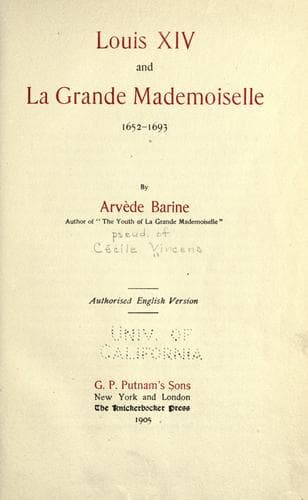
Louis XIV and La Grande Mademoiselle, 1652-1693Barine, Arvède
History
Louis XIV and La Grande Mademoiselle, 1652-1693
Barine, Arvède
Louis XIV, King of France, 1638-1715; Montpensier, Anne-Marie-Louise d'Orléans, duchesse de, 1627-1693
A final misdeed, and not the least for which the absolute regime is
responsible, was the launching of the nation in pursuit of one of the
most dangerous of political chimeras, that of the need of spiritual
unity. Louis XIV. revoked the Edict of Nantes in the name of the fetich
that a good Frenchman must be of his King's faith. A century later, the
Terror cut off heads in the name of a unity of opinion, because a
Frenchman ought to be virtuous in the fashion of Rousseau and of
Robespierre. The reader may continue for himself the series, and count
the acts of oppression committed in the nineteenth century, while even
the twentieth century, young as it still is, presents examples of the
attempt to enforce upon the nation a uniformity of thought which, if
once attained, would signify intellectual death. For in politics, as in
religion, as in art, in literature, in all, diversity is life.
It is through this capital error that the reign of Louis XIV., so
glorious in many respects, was the precursor of the great Revolution and
really made its coming inevitable. The Jacobins are in some measure the
heirs of the great King. Fundamentally, the mania for spiritual and
moral unity is simply, under a less odious name, the horror of liberty;
a sentiment old as the world, but which in the earlier portion of the
seventeenth century had been far from dominant. The word "liberty"
occurs again and again in the writings of many people of that period,
theorists, jurists, and great nobles, at every point in which they touch
politics. The expression contained for them nothing revolutionary. What
they were demanding was rather a return to past methods, and, above all,
it did not enter their thoughts to associate with liberty the word
"equality." It is the eighteenth century, more philosophical, if perhaps
less reasonable, that first conceived the idea of uniting two really
incompatible things, without perceiving that one of the two was destined
to annihilate the other.
If absolute royalty had remained at Paris, it would have clearly
realised the point at which the nation no longer was in sympathy with
its rule. At Versailles it saw nothing; it shut itself up in its own
tomb. The divorce was consummated between the Court and the Capital, one
contenting itself with being figurative and ornamental, the other
actively controlling opinions, since royalty had renounced the office of
directing the public mind and thoughts.
Public-domain text, read in full here on John Shaqi.
Reviews
Reviews
No reviews yet
Be the first to share your thoughts on this work.
Elsewhere in the archive
Join the Discussion
Join the discussion
Sign in to leave a comment or review.
Sign InorCreate an account