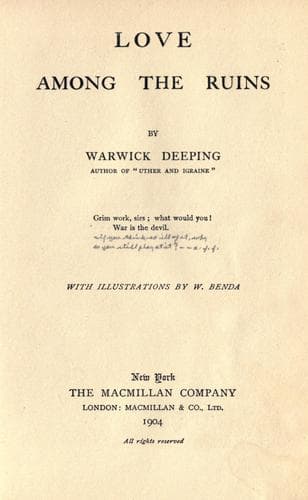
Great Britain -- History -- Medieval period, 1066-1485 -- Fiction; Man-woman relationships -- Fiction
Towards evening, human wreckage began to drift in from the country,
bearing lamentable witness to the thoroughness of Fulviac’s
incendiarism. Gambrevault might have stood for heaven by the strange
scattering of folk who came to seek its sanctuary. Fire and sword were
abroad with a vengeance; cottars, borderers, and villains had risen in
the night; treachery had drawn its poniard; even the hound had snapped
at its master’s hand.
Many pathetic figures passed under the great arch of Gambrevault gate
that day. First a knight came in on horseback, a baby in his arms, and
a woman clinging behind him, sole relics of a home. Margaret, the
grey-haired countess of St. Anne’s, was brought in on a litter by a few
faithful men-at-arms; her husband and her two sons were dead. Young
Prosper of Fountains came in on a pony; the lad wept like a girl when
questioned, and told of a mother and a sire butchered, a home sacked and
burnt. There were stern faces in Gambrevault that day, and looks more
eloquent than words. "Verily," said Flavian to Modred the Strong, "we
shall have need of our swords, and God grant that we use them to good
purpose."
So night drew near, and still no riders had come from the companies that
had ridden out to reconnoitre towards Gilderoy and Geraint. Flavian had
had a hundred duties on his hands: exercising his courtesy to the
refugees, condoling, reassuring; inspecting the defences and the siege
train; superintending the victualling of the place. He had ordered his
troops under arms in the meadows, and had spoken to them of what had
passed at Gilderoy, and what might be looked for in the future. There
seemed no lack of loyalty on their part. Flavian had ever been a
magnanimous and a generous overlord, glad to be merciful, and no
libertine at the expense of his underlings. His feudatories were bound
to him by ties more strong than mere legalities. They cheered him
loudly enough as he rode along the lines in full armour, with fifty
knights following as his guard.
Night came. Outposts had been pushed forward to the woods, and a strong
picket held the ford across the river. On the battlements guards went to
and fro, and clarions parcelled out the night, and rang the changes. In
the east there was a faint yellowish light in the sky, a distant glare
as of a fire many miles away. In the camp men were ready to fly to arms
at the first thunder of war over the hills.
Flavian held a council in the great hall, a council attended by all his
knights and captains. They had a great map spread upon the table, a
chart of the demesnes of Gambrevault and Avalon, and the surrounding
country. Their conjectures turned on the possible intentions of the
rebels, whether they would venture on a campaign in the open, or lie
snug within walls and indulge in raids and forays. And then--as to the
loyalty of their own troops? On this point Flavian was dogmatic, having
a generous and over-boyish heart, not quick to credit others with
treachery.
Public-domain text, read in full here on John Shaqi.
Reviews
Reviews
No reviews yet
Be the first to share your thoughts on this work.
Elsewhere in the archive
Join the Discussion
Join the discussion
Sign in to leave a comment or review.
Sign InorCreate an account