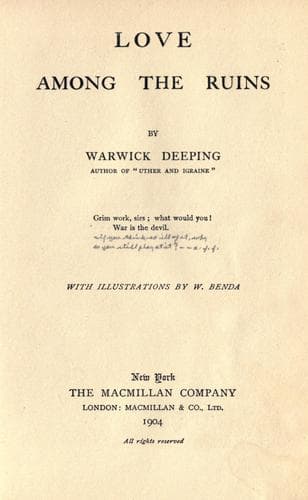
Great Britain -- History -- Medieval period, 1066-1485 -- Fiction; Man-woman relationships -- Fiction
Paris and Helen have been dead centuries, yet in that universal world of
the mind they still live, young and glorious as when the Grecian galleys
ploughed foam through the blue Ægean. The world loves a lover. Troilus
stages our own emotions for us in godlier wise than we poor realists can
hope to do. We owe an eternal gratitude to those who have stood for
love in history. All men might well desire to play the Tristan to
Iseult of the Irish eyes. We forget Gemma Donati, and follow with
Dante’s wistful idealism the gleaming figure of Beatrice in Paradise.
Now the Lord Flavian was one of those happy persons who seem to stumble
into heaven either by prodigious instinct or remarkable good-fortune.
God gives to many men gold; to others intellect; to some truth; to few,
a human echo, a harmony in the spirit, the right woman in the world.
Many of us are such unstable folk that we vibrate vastly to a beautiful
face and hail heaven in a pair of violet eyes. The chance is that such
a business turns out miserably. It is a wise rule to search the world
through to find your Beatrice, or bide celibate to the end. Happy is
the man whose instinctive choice is ratified by all the wisest poetry of
heaven. Happy is he who finds a ruby as he rakes the ephemeral
flower-gardens of life, a gem eternally bright and beautiful, durable,
unchanging, flashing light ever into the soul. It is given to few to
love wisely, to love utterly, to love till death.
That summer day Flavian saw life at its zenith, as he rode through the
woods on the way to Gambrevault. The horse had dropped to a trot, and
the man had taken off his helmet and hung it at his saddle-bow. He was
still red from the mêlée; his eyes were bright and triumphant. The girl
at his side looked at him half-timidly, a tremor upon her lip, her
glances clouded. The terrific action of the last hour still seemed to
weigh upon her senses, and she seemed fated to be the sport of
contending sentiments. No sooner had she struggled to some level of
saintliness than love rushed in with burning wings, and lo, all the
tinsel of her religion fell away, and she was a mere Eve, a child of
Nature.
Flavian watched her with the tenderness of a strong man, who is ready to
give his life for the woman he serves. Love seemed to rise from her and
play upon him like perfume from a bowl of violets; her eyes transfigured
him, and he longed to touch her hair.
"At last."
"Lord?"
"Treat me as a man, I hate that epithet."
"You are a great signor."
"What are titles, testaments, etiquettes to us! I am only great so long
as you trust and honour me."
"Your power might appear precarious."
"As you will."
"Yet war is loose!"
He looked round upon the sea of men that rolled on every hand.
"And war at its worst. I have seen enough in three days to make me
loathe your partisans and their principles."
"Perhaps."
"It is a wicked and inhuman business."
"What are you going to do with me?" she said.
Public-domain text, read in full here on John Shaqi.
Reviews
Reviews
No reviews yet
Be the first to share your thoughts on this work.
Elsewhere in the archive
Join the Discussion
Join the discussion
Sign in to leave a comment or review.
Sign InorCreate an account