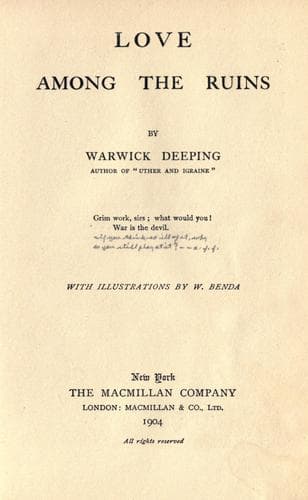
Great Britain -- History -- Medieval period, 1066-1485 -- Fiction; Man-woman relationships -- Fiction
He lodged her in a chamber in the keep, a room that had been his
mother’s and still held the furniture, books, and music she had used.
Its window looked out on the castle garden, and over the double line of
walls to the meadows and woods beyond. Maud, the castellan’s wife, was
bidden to wait upon her. Flavian gave her the keys of his mother’s
chests, where silks, samites, sarcenets galore, lace and all manner of
golden fripperies, were stored. The ewers of the room were of silver,
its hangings of violet cloth, its bed inlaid with ivory and hung with
purple velvet. It had a shelf full of beautifully illumined books, a
prayer-desk and a small altar, a harp, a lute, an embroidery frame, and
numberless curios. Thus by the might of the sword Yeoland was installed
in the great castle of Gambrevault.
So Duessa and Balthasar were dead. The girl had told Flavian what had
passed in Sforza’s palace; the news shocked him more than he would have
dreamed. The dead wound us with their unapproachableness and the mute
pathos of their pale, imagined faces. They are like our own sins that
stare at us from the night sky, irrevocable and beyond us for ever.
Flavian ordered tapers to be burnt and masses said in the castle chapel
for the souls of these two unfortunates. He himself spent more than an
hour in silent prayer before he confessed, received penance and
absolution.
That evening, at Flavian’s prayer, Yeoland came down to meet him in the
castle garden, with the castellan’s two girls to serve her as maids of
honour. She had put aside her armour, and was clad in a jacket of
violet cloth, fitting close to the figure, and a skirt of light blue
silk. In the old yew walk, stately and solemn, amid the bright parterres
and stone urns gushing colour, the two children slipped away and left
Yeoland and the man alone.
She seemed to have lost much of her restraint, much of her independence,
of her reserve, in a few short hours. Her mood inclined towards silence
and a certain delightful solemnity such as a lover loves. Her eyes met
the man’s with a rare trust; her hands went into his with all the ideal
faith he had forecast in his dreams.
They stood together under the yews, full of youth and innocent joy of
soul, timid, happily sad, content to be mere children. Flavian touched
her hands as he would have touched a lily. She seemed too wonderful,
too pure, too transcendent to be fingered. A supreme, a godly timidity
possessed him; he had such love in his heart as only the strong and the
pure can know, such love as makes a man a saint unto himself, a being
wrapped round with the rarest chivalry of heaven.
Their words were very simple and infrequent.
"I have been thinking," said the girl.
"Yes?"
"How war seems ever in the world."
"How else should I have won you?"
She sighed and looked up over his shoulder at the sunlight glimmering
gold through the yews.
Public-domain text, read in full here on John Shaqi.
Reviews
Reviews
No reviews yet
Be the first to share your thoughts on this work.
Elsewhere in the archive
Join the Discussion
Join the discussion
Sign in to leave a comment or review.
Sign InorCreate an account