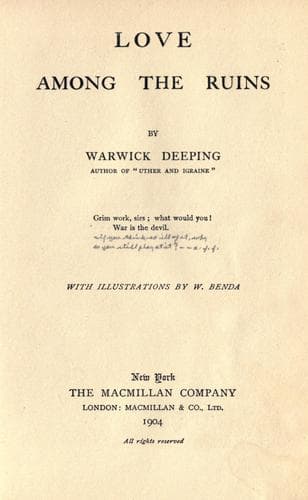
Great Britain -- History -- Medieval period, 1066-1485 -- Fiction; Man-woman relationships -- Fiction
She ran to him suddenly and seized his wrist.
"GO----!"
"I cannot."
"Men are coming, I hear them in the woods, they will kill you!"
"I hear them too."
"Go, go, for my sake and for God’s."
He kissed her sleeve, pulled his cowl down, and fled away into the
woods.
XVII
The Lady Duessa stood in the chapel of water-girded Avalon, with Fra
Balthasar the Dominican beside her. She had slipped in without his
noticing her, and had watched him awhile in silence at his work. The
jingling of her chatelaine had brought him at last to a consciousness of
her presence. Now they stood together before the high altar and looked
at the Madonna seated on her throne of gold, amid choirs of angel women.
The Lady Duessa’s intelligence had waxed critical on the subject.
"You have altered the Virgin’s face," she said.
Balthasar stared at his handiwork and nodded.
"The former has been erased, the latter throned in her stead."
The words had more significance for the lady than the friar had perhaps
intended. A better woman would have snubbed him for his pains. As it
was, he saw her go red, saw the tense stare of her dark eyes, the
tightening of the muscles of her jaw. She had a wondrous strong jaw,
had the Lady Duessa. She was no mere puppet, no bright-eyed, fineried
piece of plasticity. Fra Balthasar guessed the hot, passionate power of
her soul; she was the very woman for the rough handling of a cause, such
as the Lord Flavian her husband had roused against her.
"I suppose," she said, "this alteration was a matter of art, Balthasar?"
"A matter of heart, madame."
"So?"
"My Lord Flavian commanded it."
"And yonder face is taken from life?"
"Madame, I leave the inference to your charity."
She laughed a deep, cynical laugh, and went wandering round the chapel,
looking at the frescoes, and swinging a little poniard by the chain that
linked it to her girdle. Balthasar made a pretence of mixing colours on
his palette. Worldly rogue that he was, he knew women, especially women
of the Lady Duessa mould. He had a most shrewd notion as to what was
passing in her mind. Morally, he was her abettor, being a person who
could always take a woman’s part, provided she were pretty. He believed
women had no business with religion. To Balthasar, like fine glass,
their frailty was their most enhancing characteristic. It gave such
infinite scope to a discreet confessor.
The Lady Duessa strolled back again, and stood by the altar rails.
"Am I such a plain woman?" she asked.
"Madame!"
"You have never painted me."
"There are people above the artist’s brush."
"But you paint the Madonna."
"Madame, the Madonna is anybody’s property."
"Am I?"
"God forbid that a poet should speak lightly of beauty."
She laughed again, and touching her hair with her fingers, scanned
herself in a little mirror that she carried at her girdle.
"Tell me frankly, am I worth painting?"
Public-domain text, read in full here on John Shaqi.
Reviews
Reviews
No reviews yet
Be the first to share your thoughts on this work.
Elsewhere in the archive
Join the Discussion
Join the discussion
Sign in to leave a comment or review.
Sign InorCreate an account