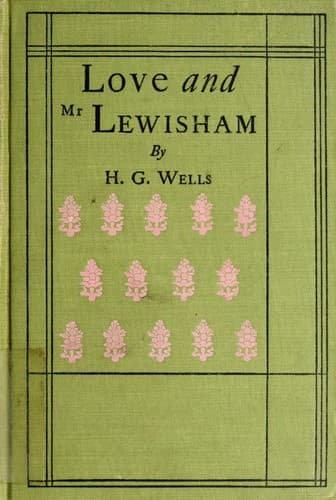
Love and Mr. LewishamWells, H. G. (Herbert George)
General
Love and Mr. Lewisham
Wells, H. G. (Herbert George)
Love stories; Man-woman relationships -- Fiction; Satire; Spiritualists -- England -- Fiction
The only response to this was to shout, and Lewisham shouted. "You
start a quarrel!" he repeated. "You make a shindy! You spring a
dispute--jealousy!--on me! How can I do anything? How can one stop in
a house like this? I shall go out. Look here!--I shall go out. I shall
go to Kensington and work there!"
He perceived himself wordless, and Ethel was about to speak. He glared
about him, seeking a prompt climax. Instant action was necessary. He
perceived Huxley's _Vertebrata_ upon the side-table. He clutched it,
swayed it through a momentous arc, hurled it violently into the empty
fireplace.
For a second he seemed to be seeking some other missile. He perceived
his hat on the chest of drawers, seized it, and strode tragically from
the room.
He hesitated with the door half closed, then opened it wide and
slammed it vehemently. Thereby the world was warned of the justice of
his rage, and so he passed with credit into the street.
He went striding heedless of his direction through the streets dotted
with intent people hurrying to work, and presently habit turned his
feet towards the Brompton Road. The eastward trend of the morning
traffic caught him. For a time, save for a rebellious ingredient of
wonder at the back of his mind, he kept his anger white and pure. Why
had he married her? was the text to which he clung. Why in the name of
destiny had he married her? But anyhow he had said the decisive
thing. He would not stand it! It must end. Things were intolerable and
they must end. He meditated devastating things that he might presently
say to her in pursuance of this resolution. He contemplated acts of
cruelty. In such ways he would demonstrate clearly that he would not
stand it. He was very careful to avoid inquiring what it was he would
not stand.
How in the name of destiny had he come to marry her? The quality of
his surroundings mingled in some way with the quality of his
thoughts. The huge distended buildings of corrugated iron in which the
Art Museum (of all places!) culminates, the truncated Oratory all
askew to the street, seemed to have a similar quarrel with fate. How
in the name of destiny? After such high prolusions!
He found that his thoughts had carried him past the lodge of the
museum. He turned back irritably and went through the turnstile. He
entered the museum and passed beneath the gallery of Old Iron on his
way to the Education Library. The vacant array of tables, the bays of
attendant books had a quality of refuge....
So much for Lewisham in the morning. Long before midday all the vigour
of his wrath was gone, all his passionate conviction of Ethel's
unworthiness. Over a pile of neglected geological works he presented a
face of gloom. His memory presented a picture of himself as noisy,
overbearing, and unfair. What on earth had it all been about?
Public-domain text, read in full here on John Shaqi.
Reviews
Reviews
No reviews yet
Be the first to share your thoughts on this work.
Elsewhere in the archive
Join the Discussion
Join the discussion
Sign in to leave a comment or review.
Sign InorCreate an account