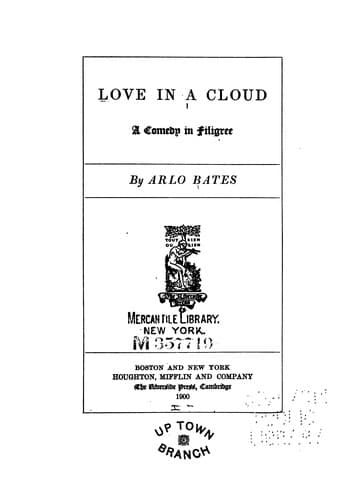
Anonyms and pseudonyms -- Fiction; Authorship -- Fiction; Boston (Mass.) -- Social life and customs -- Fiction
"You horrid thing!" she pouted. "I've a great mind to break the
engagement now. I have been engaged, though," she added, bursting into
a laugh of pure glee. "You forget that I woke up this morning engaged
to one man and shall go to sleep engaged to another."
"Dear old Jack!" Fairfield said fervently. "Well, I must go home and
find him. I want to tell him the news. Heavens! I had no idea it was so
late!"
"It isn't late," May protested, after the fashion of all girls in her
situation, both before and since; but when Dick would go, she laughingly
said: "You tell Jack if he were here I'd kiss him. He said I'd want to
some time."
And after half an hour of adieus and a brisk walk home, Dick delivered
the message.
XXIII
THE BUSINESS OF A MUSE
The decadence of literature began insensibly with the invention of
printing, and has been proceeding ever since. How far it has proceeded
and whether literature yet exists at all are questions difficult if not
impossible to answer at the present time, because of the multitude of
books. No living man can have more than a most superficial knowledge of
what is being done in what was formerly the royalty and is now the
communism of letters. A symphony played in the midst of a battle would
stand much the same chance of being properly appreciated as would to-day
a work of fine literary worth sent forth in the midst of the innumerous
publications of the age.
Men write, however, more than ever. There is perhaps a difference, in
that where men of the elder day deluded themselves or hoped to delude
others with impressive talk about art and fame and other now obsolete
antiquities, the modern author sets before him definite and desirable
prizes in the shape of money and of notoriety which has money's worth.
The muse of these days is confronted on the door of the author with a
stern "No admittance except on business," and she is not allowed to
enter unless she bring her check-book with her. The ideal of art is
to-day set down in figures and posted by bankers' clerks. Men once
foolishly tried to live to write; now they write to live. If men seek
for Pegasus it is with a view to getting a patent on him as a
flying-machine; and the really progressive modern author has much the
same view of life as the rag-picker, that of collecting any sort of
scraps that may be sold in the market.
Public-domain text, read in full here on John Shaqi.
Reviews
Reviews
No reviews yet
Be the first to share your thoughts on this work.
Elsewhere in the archive
Join the Discussion
Join the discussion
Sign in to leave a comment or review.
Sign InorCreate an account