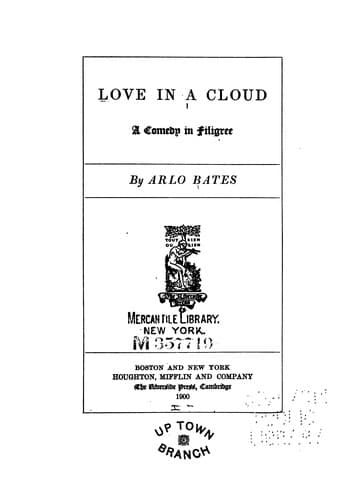
Anonyms and pseudonyms -- Fiction; Authorship -- Fiction; Boston (Mass.) -- Social life and customs -- Fiction
All the way into town that sunny April afternoon Harry Bradish was
unusually silent. While Mrs. Neligage, in the highest spirits, rattled
on with jest, or chat, or story, he replied in monosyllables or in the
briefest phrases compatible with politeness. He was evidently thinking
deeply. The very droop of his yellow mustaches showed that. The presence
of the trig little groom at the back of the trap was a sufficient reason
why Bradish should not then deliver up any confidential disclosures in
regard to the nature of his cogitations, but from time to time he
glanced at the widow with the air of having her constantly in his
thoughts.
Bradish was the most kindly of creatures, and withal one of the most
self-distrustful. He was so transparent that there was nothing
surprising in the ease with which one so astute as Mrs. Neligage might
read his mood if she were so disposed. He cast upon her looks of inquiry
or doubt which she gave no sign of perceiving, or now and then of
bewilderment as if he had come in his thought to a question which
puzzled him completely. During the entire drive he was obviously
struggling after some mental adjustment or endeavoring to solve some
deep and complicated problem.
The day was enchanting, and in the air was the exciting stir of spring
which turns lightly the young man's fancy to thoughts of love. Whether
Bradish felt its influence or not, he had at least the air of a man
emotionally much stirred. Mrs. Neligage looked more alert, more
provoking, more piquant, than ever. She had, it is true, an aspect less
sentimental than that of her companion, but nature had given to Harry
Bradish a likeness to Don Quixote which made it impossible for him ever
to appear mischievous or sportive, and if he showed feeling it must be
of the kindly or the melancholy sort. The widow might be reflecting on
the effectiveness of the turnout, the fineness of the horses, the
general air of style and completeness which belonged to the equipage, or
she might be ruminating on the character of the driver. She might on
the other hand have been thinking of nothing in particular except the
light things she was saying,--if indeed it is possible to suppose that a
clever woman ever confines her thoughts to what is indicated by her
words. Bradish, however, was evidently meditating of her.
When he had brought the horses with a proper flourish to Mrs. Neligage's
door, Bradish descended and helped her out with all his careful
politeness of manner. He was a man to whom courtesy was instinctive. At
the stake he would have apologized to the executioner for being a
trouble. He might to-day be absorbed and perplexed, but he was not for
that less punctiliously attentive.
"May I come in?" he asked, hat in hand.
"By all means," Mrs. Neligage responded. "Come in, and I'll give you a
cup of tea."
Public-domain text, read in full here on John Shaqi.
Reviews
Reviews
No reviews yet
Be the first to share your thoughts on this work.
Elsewhere in the archive
Join the Discussion
Join the discussion
Sign in to leave a comment or review.
Sign InorCreate an account