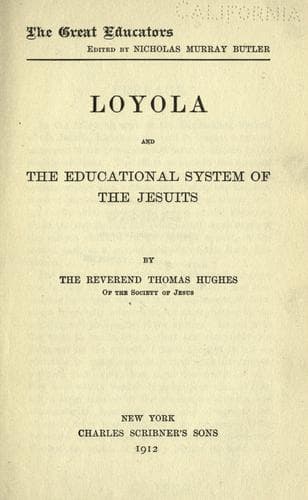
Loyola and the Educational System of the JesuitsHughes, Thomas
History
Loyola and the Educational System of the Jesuits
Hughes, Thomas
Education -- History; Ignatius, of Loyola, Saint, 1491-1556; Jesuits
To say a word upon this class of Jesuit students, they show us the
Professor's formation at its last stage. They are reviewing all
Theology, Philosophy, Sacred Scripture, Canon Law, Polemical or
Controversial Theology, and ecclesiastical erudition generally. The
last of their rules for self-guidance says: "In particular, they are
to devote themselves most of all to that pursuit, to which they feel
chiefly drawn, without, however, omitting any of the rest."[232]
Meanwhile, they present, in various ways, specimens of their talent
and erudition; they throw into the form of a digest, "from their
own genius," all Theology, under certain heads and principles; they
can choose some "splendid subject,"[233] and deliver ten public
lectures thereupon to the auditors who choose to attend, which, we may
observe, was precisely the status of all Professors in the mediæval
universities. In their acts of public defence, five of which are
prescribed during the two years, they are free to follow or to leave
the opinions of their late Professors.[234]
These students then are assistant and extraordinary Professors. They
have begun the work, which some of them will continue when called upon
to become Professors in ordinary. They are already in training for
that independent work, which the revised _Ratio_ of 1832 shows some
anxiety about preserving; for it says to all who occupy any chair in
these faculties, that, in case they adopt a standard author to follow
in their lectures, which is a custom rather prevalent in more recent
times, they must nevertheless deliver each year some special question
elaborated independently by themselves.[235] This independence of
style, perfect command of the matter, with express leave for the
incipient Professor, in the course of his final biennium, to relinquish
the opinions of his late Professors, are made the subject of many a
remark by the critics of 1586. Withal, it is clear enough that for a
younger man to leave an approved opinion safely, it is very necessary
for him to know well what he is about; and doubly necessary when he
comes forward in a public defence; for his own late Professors are
among the Doctors present, and are there to assail him in all his
tenets.
These, then, or others presiding over the circles, "one person repeats,
the others listening; they propose difficulties mutually, and, if they
cannot solve their own objections, they consult the Professor."[236]
The one who repeats is to do so, not from his notes, but from memory.
Thus "the memory is exercised; practice is afforded those who are to
be Masters, so that they accustom themselves to develop their thoughts
before others; it makes them all keep alive and attentive during the
lecture, to take down the necessary notes, as they might not do, if
they were free from such repetition."[237] There are several other
possible forms of conducting this exercise.
Public-domain text, read in full here on John Shaqi.
Reviews
Reviews
No reviews yet
Be the first to share your thoughts on this work.
Elsewhere in the archive
Join the Discussion
Join the discussion
Sign in to leave a comment or review.
Sign InorCreate an account