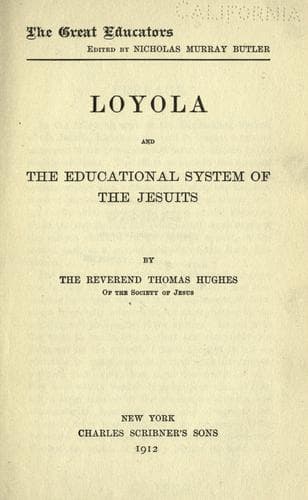
Loyola and the Educational System of the JesuitsHughes, Thomas
History
Loyola and the Educational System of the Jesuits
Hughes, Thomas
Education -- History; Ignatius, of Loyola, Saint, 1491-1556; Jesuits
Quod si charta cadat, secum sapientia vadat,[271]
Possevino goes on to plead for the chests of the students, and says
that the ink is the price of their blood, and the end of their studies
becomes the end of their lives. Hence one singular result of it all
is, that scholars even employ amanuenses to go to school instead of
themselves, and bring back in writing what was said. But all that
money, says Possevino, could have been reserved for the buying of
books, to supplement real study.
Then he enforces what he has said with a piece of university history,
wherein perhaps no one of his time was better versed. The University
of Paris, two and a half centuries before, had legislated against
dictating, and against the Doctors who used it, and who were dubbed
_Nominatores ad pennam_. One century before, the Cardinal Legate had
again formulated a law on the subject. And finally the Jesuits, "of
whom a great number are chiefly engaged in this profession, taught
by experience the evils of that system, have long understood the
necessity, not merely of moderating it, but simply doing away with it.
Wherefore the Fathers in the universities of Portugal have already
published a part of Natural Philosophy, whereby writing is dispensed
with, room is left for quickening genius, and much material stored up
to bring into the arena of discussion."[272]
CHAPTER XV.
FORMATION OF THE SCHOLAR. SYMMETRY OF THE COURSES. THE PRELECTION.
BOOKS.
What is developed to perfection can make other things like unto itself;
it is prolific. So the Aristotelian principle has it: _Perfectum est,
quod generat simile sibi._ This is the outcome and test of perfection.
Having followed the Master, therefore, till he was complete in his
own formation, we have now turned to look in another direction, and
see him reacting upon those whom he is to form. Though much has been
said already implicitly or otherwise, on the method and principles of
this reactive process, yet something remains, especially with regard
to the lower faculties, the literary courses. In this chapter, we may
consider the attitude which the Professors take, singly and as a body,
towards the students and towards their own courses; and then their
chief manner of imparting knowledge, or what is called in the _Ratio_
the _prælectio_. In the next chapter we can survey the principal class
exercises, and the method of school management, throughout the lower
grades. And, in the chapter after that, I shall sketch the system of
grades from the lowest to the highest.
Public-domain text, read in full here on John Shaqi.
Reviews
Reviews
No reviews yet
Be the first to share your thoughts on this work.
Elsewhere in the archive
Join the Discussion
Join the discussion
Sign in to leave a comment or review.
Sign InorCreate an account