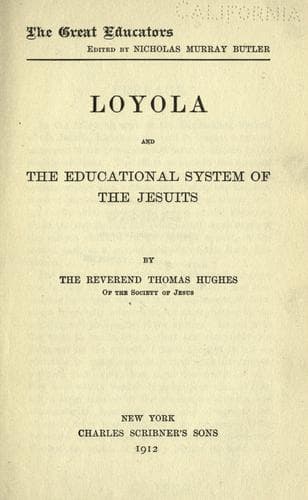
Loyola and the Educational System of the JesuitsHughes, Thomas
History
Loyola and the Educational System of the Jesuits
Hughes, Thomas
Education -- History; Ignatius, of Loyola, Saint, 1491-1556; Jesuits
=Scholastic Theology.= FOUR YEARS. _Two Professors: each four hours
a week._ _One course._ Religion and the Church; God in Unity and
Trinity; His attributes, predestination: God as Creator; the Angels;
the creation of Man and his fall; the Incarnation; Three of the Seven
Sacraments. _The other course._ Human acts, virtues, and vices; the
theological virtues; the cardinal virtues; right and justice; religion;
grace; the Sacraments in general; the rest of the Seven Sacraments.
=Moral Theology.= TWO YEARS. _One Professor: five and a half hours a
week._ The scope of this course is to form Ministers of the Sacraments.
_One year._ Human acts, conscience, laws, sins, the Commandments,
excepting the seventh. _The other year._ The seventh Commandment, which
includes contracts; the Sacraments, censures, the states and duties of
life.
=Ecclesiastical History.= TWO YEARS. _One Professor: two hours a week._
The questions, necessary and opportune, in the history of each century.
=Canon Law.= TWO YEARS. _One Professor: two hours a week._ _One year._
Persons, judgments, penalties. _The other year._ Things.
=Sacred Scripture.= TWO YEARS. _One Professor: four hours a week._
General prolegomena. A book from the Old and New Testament alternately.
=Hebrew.= ONE YEAR. _One Professor: two hours a week._ Supplemented
with one hour a week on Syriac, Arabic, Chaldaic, during four years.
GENERAL DISTRIBUTION OF TIME.
The compilers of the preliminary _Ratio_ made an effort to draw up a
uniform system for the distribution of time in the various countries.
But the final _Ratio_ preferred to leave the matter thus: "Since the
variety of countries, times, and persons is apt to introduce variety
in the order to be observed, and in the distribution of hours for
study, repetitions, disputations, and other exercises, as also in
vacations, the proper authority will report to the General whatever he
thinks more expedient in his Province, for the better advancement of
studies, that a definite arrangement may be come to, which will meet
all exigencies; keeping, however, as near as possible to the common
order of our studies."[348] Accordingly, a rule of the General Prefect
of Studies prescribes that "he lay down not only an order of studies,
repetitions, disputations to be observed by members of the Society, by
our scholars, and by external students at large, under the direction of
their Professors; but also that he distribute all their time, to the
effect that they spend the hours of private study well."[349]
Public-domain text, read in full here on John Shaqi.
Reviews
Reviews
No reviews yet
Be the first to share your thoughts on this work.
Elsewhere in the archive
Join the Discussion
Join the discussion
Sign in to leave a comment or review.
Sign InorCreate an account