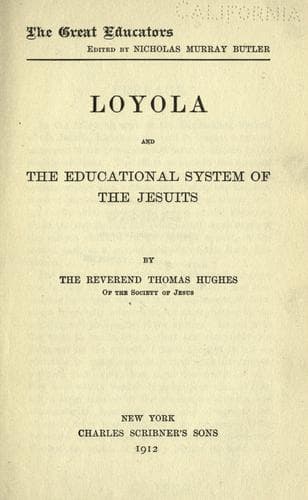
Loyola and the Educational System of the JesuitsHughes, Thomas
History
Loyola and the Educational System of the Jesuits
Hughes, Thomas
Education -- History; Ignatius, of Loyola, Saint, 1491-1556; Jesuits
Hebrew. 2 .. .. ..
Syriac, Arabic,}
Chald. } .. 1 1 1
Specialties. Outside of this Sexennium.
SUPERIOR INSTRUCTION.--(D) _Law._
Conducted by a Faculty not of the Order.
SUPERIOR INSTRUCTION.--(E) _Medicine._
Conducted by a Faculty not of the Order.
CHAPTER XVIII.
CONCLUSION.
It will not have escaped the attentive reader, that almost all the
history, pedagogic or otherwise, which has been sketched in this essay,
falls within the lines of what has been called the Counter-Reformation;
and some portion of it belongs to what is styled, in the present
century, the Counter-Revolution. For this reason, if the facts recorded
seem at all new, he will discern the reason. They have lain outside of
one of the beaten paths in history.
Beyond the facts of evolution, as they may have appeared in these
pages, I do not pretend to have found a place for this system
in any plan of pedagogic development. Nor do I lay claim to the
far-sightedness which may discern any posthumous development, as the
legacy of this system to the world of education. Politically, its
place has often been assigned to it summarily by main force. But,
pedagogically, too, the day may come, when gathered to the other
remains which moulder in the past, it can look down from a grade and
place of its own in evolution, and look out, like others, on a progeny
more favored than itself, the fair mother of fairer children; even as
the old university system of mediæval Europe, particularly that of the
great University of Paris, can look down from its silent and solemn
place in history, as the direct progenitor of the _Ratio Studiorum_.
"We, too, have been taught by others," said Possevino in 1592. Indeed,
as is evident, the last thing which the system ever seems to dream of,
which never, in fact, crosses the path of its intellectual vision, is
that it is playing the rôle, perchance, of a pedagogic adventurer,
or courting notice by some new and striking departure. No doubt, in
its integrity, it is singularly the system of the Jesuits, and, in a
multitude of practical elements, it embodies the elaborate experience
of one practical organization of men. But, none the less, if we look
down for its foundations, we pass through the Renaissance of Letters,
and find the traditions of scholastic Europe; and further down still,
in the stratification of history, we come to the principles of
education as defined by Aristotle, Plato, and Socrates.
Public-domain text, read in full here on John Shaqi.
Reviews
Reviews
No reviews yet
Be the first to share your thoughts on this work.
Elsewhere in the archive
Join the Discussion
Join the discussion
Sign in to leave a comment or review.
Sign InorCreate an account